 The
The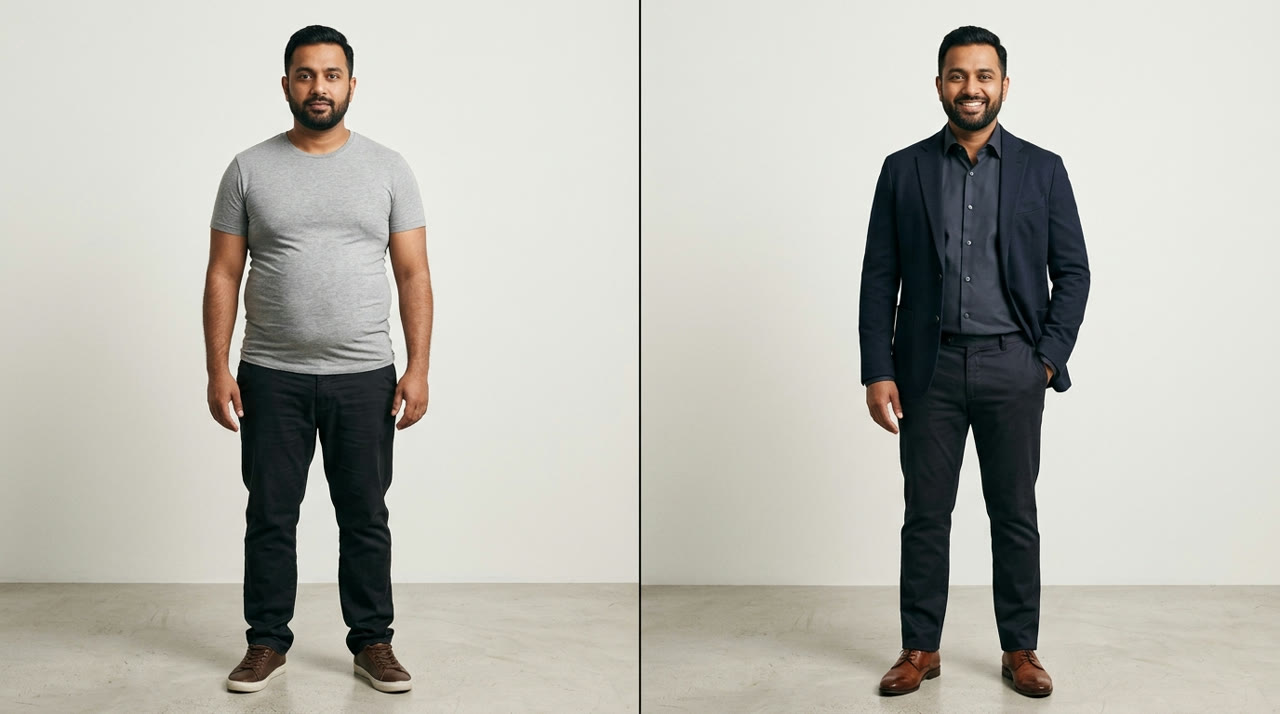
Every shirt you own either pulls at the third button or hangs like a tent everywhere else. Tuck it in and you get a crease running straight across the part of you you'd rather not draw attention to; leave it out and it looks like you gave up.
None of this means you need to lose weight before you're allowed to dress well. It means most of what's in your wardrobe is cut for a different shape than yours. A man carrying weight around the middle — the build everyone now calls a “dad bod” — needs different rules for cut, rise, layering and fabric, not a diet plan and a deadline.
This is a fit guide, not a fitness one. Get the four levers below right — shirt cut, trouser rise, jacket structure and fabric choice — and you'll look sharper in the body you have this week, in Indian heat, for work, weddings or a first date.
Why “lose weight” isn't the fix — fit is
Most style advice aimed at heavier men starts with a diet plan. Ignore it. Nothing about looking sharp requires a smaller stomach — it requires clothes engineered for the body you actually have.
A well-dressed man with a fuller midsection isn't hiding his belly under baggy fabric. He's using four things most men never adjust: the cut of his shirt, the rise of his trouser, the structure of his jacket, and the weight of his fabric. Change those four and the silhouette reads broader through the shoulders, straighter through the torso, and far less round — without a single day at the gym.
Your body also isn't static — work stress, age and simply having a family change it, and that's normal, not a failure. We've written a broader guide on dressing well when your body is changing. This piece is the specific playbook for carrying weight around the middle.
If you'd rather skip the trial and error, TheGent's Style Report reads your exact frame and hands you these rules already worked out — not generic ones.
Shirts: the fit that actually flatters a belly
Slim-fit shirts are the single biggest mistake. They're cut to taper sharply from chest to waist, so on a fuller stomach they pull at the buttons and gape — which is the opposite of flattering.
Go semi-fitted instead of slim or boxy. A semi-fitted (sometimes labelled “classic” or “comfort” fit) shirt tapers gently and leaves an inch of ease at the stomach, so the fabric skims rather than strains.
- Fabric weight: mid-weight cotton (poplin or oxford) holds its shape; thin, flimsy cotton creases and clings the moment you sit down.
- Length: a shirt cut to be tucked should reach just past your hip bone — long enough to stay tucked when you sit, short enough that it doesn't bunch.
- The tuck: a neat single tuck works if the shirt and trouser rise are matched. If you're not sure, a half-tuck (tucked only at the front, near the fly) breaks up the horizontal waistline and looks deliberate, not sloppy.
If you're also carrying weight through the chest, the same logic applies one level up — here's how to minimise a fuller chest without switching to shapeless shirts entirely.
The rule: a shirt should skim your stomach, never hug it or bury it under three sizes of spare fabric.
Get all of this decided for your exact features
Everything here is general. Your TheGent Style Report turns your own face shape, body type and skin tone into a personal system — 2 hairstyles, fit rules, a 23-colour palette and 28 outfits built for you, in 48 hours.
Get your Style Report →Trousers: rise, break and the waistband rule
Low-rise trousers are the second biggest mistake. When the waistband sits below your stomach, the belly spills over it — that's the “shelf” effect, and no shirt fixes it.
- Rise: choose a mid-to-high rise that sits at or just above your natural waist. The waistband should hold your stomach in, not push it up and over.
- Pleats: a single forward or reverse pleat gives extra room through the seat and thigh without clinging — don't rule pleated trousers out. A too-tight flat-front that pulls at the fly looks worse than a well-cut pleat.
- Break: a slight break, where the hem just touches the shoe, elongates the leg. No break at all (or a cropped hem) shortens your proportions and puts more visual weight on your stomach by comparison.
- Leg shape: straight or gently tapered from the thigh down balances a fuller middle. Skinny-fit trousers do the opposite — they make the top half look heavier by contrast.
If your waistband gaps when you sit, that's a sizing problem, not a belt problem. Size the waist correctly and take the seat in, or use braces instead of cinching a too-big waist with a belt.
Jackets and layering that skim, not cling
A structured jacket is one of the fastest fixes available to you. The shoulder line adds width up top, which automatically makes the middle look narrower by proportion — the same principle stylists use for pear-shaped women, just in reverse.
- Button stance: a single-breasted, two-button jacket with the button sitting at or just above your natural waist elongates the torso. A low stance drags the eye down to your stomach.
- Length: the jacket should cover your seat and reach just past the widest point of your hip. Too short and it flares open right at the button; too long and it reads as a coat.
- Double-breasted: skip it unless it's tailored precisely to you. The overlapping fabric adds bulk exactly where you don't need it.
For everyday layering — not just formal wear — open, unstructured pieces do the same job. An overshirt, an unlined bundi, or a cardigan worn open over a well-fitted T-shirt creates a vertical line down the front of your body instead of a horizontal one across it.
Collars, necklines and the vertical-line trick
Everything above your stomach is doing more work than you think. A collar or neckline that opens up your neck pulls attention up toward your face — which is the whole point.
- Collars: a spread or semi-spread collar opens the neckline and looks proportionate on a fuller face and neck. Small, pinched point collars look squeezed by comparison.
- Necklines: a slightly open collar or a V-neck under a layer elongates the neck. A crew-neck T-shirt stretched tight across the chest and stomach does the opposite — avoid wearing one as a standalone outer layer.
- Vertical lines: a single dominant colour worn head to toe (a navy shirt with navy-adjacent trousers, for instance) reads as one long column instead of two contrasting blocks split at the waist — and a column always looks leaner than a block.
This is also where an open jacket or unbuttoned overshirt earns its place: the open front placket is itself a vertical line running exactly where you want the eye to travel.
Fabrics for Indian heat that don't cling
This is the part most fit guides skip, and it matters more in India than almost anywhere else. A fabric that clings when you sweat undoes every cut decision you just made.
- Choose: mid-weight cotton, cotton-linen blends, and structured cotton-poly blends. They have enough body to skim over the stomach instead of draping straight onto it.
- Avoid: thin ribbed knits, tight lycra or spandex blends, and soft rayon. These are built to stretch and show every contour — exactly what you don't want in June in Delhi or Chennai.
- Test it: pinch the fabric. If it's thin enough to see your hand's shadow through it, it will cling the moment you sweat.
Accessible options at this weight are easy to find in India — Raymond Ready-to-Wear, Blackberrys and Allen Solly's relaxed-fit lines all stock structured cotton shirting that holds its shape through a humid commute without needing a blazer's budget.
What to avoid completely
A short list, but breaking any one of these undoes everything above.
- Tight polo T-shirts — the knit clings everywhere, especially at the stomach.
- Thin, stretchy round-neck tees worn as your only layer.
- Horizontal stripes and busy prints across the midsection.
- Over-tucking into a tight belt, which creates a visible “shelf” at the waist.
- Skinny-fit or low-rise trousers and jeans.
- Cropped or bomber-style jackets that end right at your widest point.
- Shiny or contrast-colour belts — they draw a hard horizontal line exactly where you don't want one.
Stick to solid or subtly textured pieces in colours that flatter your skin tone rather than bold horizontal patterns — colour and pattern choice does as much work as cut.
Kurtas and ethnic wear for Indian occasions
Wedding season and festive dressing follow the same rules as Western wear — most men just haven't been told the ethnic-wear version.
- Length: a straight-cut kurta falling to mid-thigh or just above the knee is your friend. A short kurta that cuts off right at your widest point does the opposite of flattering.
- Bottom: pair it with straight-fit trousers or a simple pyjama, not a fitted churidar. A tight churidar under a looser kurta creates contrast that draws the eye straight to your middle.
- Embellishment: keep heavy embroidery or patchwork at the collar, cuffs and hem, not scattered across the chest and stomach. Busy detailing at the belly is the ethnic-wear equivalent of a horizontal stripe.
- Bandhgala or Nehru jacket: choose a longer, single-breasted cut with a straight fall rather than a short, waist-length one that stops right at your stomach.
- Fabric: linen or cotton-silk blends drape cleanly and breathe through a Delhi wedding season; stiff silk or heavy brocade can look boxy on a fuller frame.
Every rule in this piece — cut, rise, colour, even your ethnic wear — is exactly what TheGent's Style Report maps to your specific face, frame and skin tone. ₹1,999, delivered in 48 hours, yours for life in the app.
- Fit fixes a belly faster than a diet — cut, rise, layering and fabric are the four levers that matter.
- Choose a semi-fitted shirt and a mid-to-high rise trouser that skim the stomach instead of clinging or gaping.
- A structured jacket with a higher button stance and vertical layering pulls the eye up, not across.
- Avoid tight polos, thin knits, horizontal stripes and over-tucking into a tight belt.
- For ethnic wear, go long and straight — a mid-thigh kurta with straight trousers, not a fitted churidar.
Frequently asked
A semi-fitted (not slim, not boxy) shirt in mid-weight cotton that skims the stomach with about an inch of ease. Pair it with a matched trouser rise and either a neat single tuck or a half-tuck at the front.
Only if the shirt's length and your trouser rise are matched — otherwise it bunches. A half-tuck, tucked in just at the front near the fly, breaks up the waistline and looks intentional even with a fuller midsection.
Yes. A single forward or reverse pleat on a well-tailored trouser gives room through the seat and thigh without clinging, which usually looks better than a too-tight flat-front pulling at the fly.
Avoid horizontal stripes, large busy prints and shiny contrast belts, since they all draw a hard line across your midsection. Solid or subtly tonal colours in shades that suit your skin tone work better.
Yes — the issue is usually an off-the-rack ‘slim fit’ cut, not your body. A jacket tailored with a structured shoulder, room through the chest and waist, and the right length will look sharp on any build.
A straight-cut kurta falling to mid-thigh or just above the knee, paired with straight-fit trousers rather than a fitted churidar, which draws attention to the stomach through contrast.