 The
The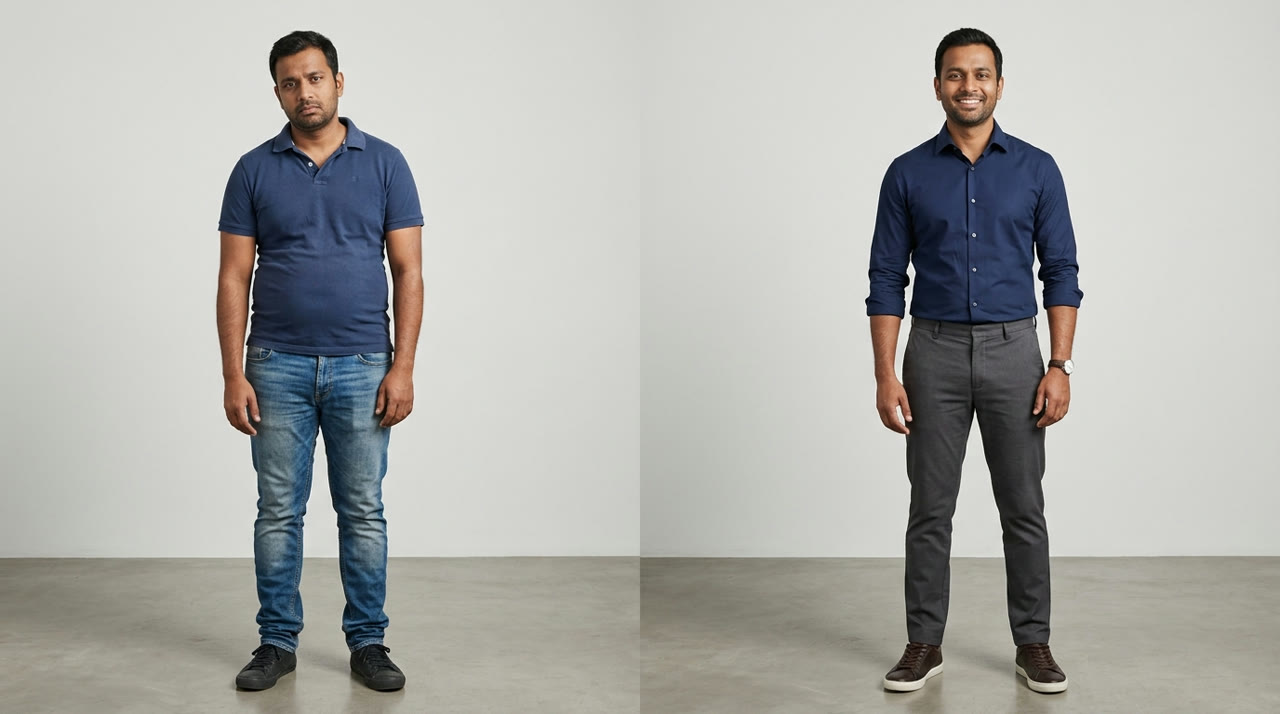
Half the clothes in your cupboard don't sit right any more, and you've started avoiding certain shirts, certain trousers, even certain photos. Maybe you've put on weight, lost it fast after a health scare, added muscle from a new gym routine, or simply watched your body settle differently into your late thirties or forties. Whatever the cause, the result is the same: nothing fits the way it used to, and getting dressed has turned into a small daily negotiation.
None of this means you did something wrong, and it isn't a problem you fix by losing or gaining a few more kilos before you're "allowed" to dress well again. Bodies change — that's normal, not a failure — and what changes with them is which cut, fit and fabric work for you, not whether you get to look sharp in the meantime.
This is a practical guide to dressing the body you actually have right now: what to buy immediately, what a tailor can save, what to retire for good, and the versatile pieces that will carry you through the transition without a full wardrobe rebuild every few months, whatever the season or occasion in India.
The real trap: dressing for the body you used to have
There are two ways men get this wrong, and both come from the same instinct: waiting.
- Squeezing into old sizes. The shirt that fit two years ago still gets worn because "it'll fit again soon" — except right now it pulls at the buttons, rides up when you sit, and makes you look heavier than you are, not leaner.
- Hoarding "someday" clothes. Trousers from your fittest year stay folded in a drawer as motivation, while the wardrobe you actually wear shrinks to five tired pieces on repeat.
Both habits are really the same mistake: dressing for a body that no longer exists, or one that doesn't exist yet, instead of the one getting you through today's meetings, commute and dinners. Wearing clothes that fit your current frame doesn't slow down a fitness goal or make a size change permanent. It just means you look put-together while you're getting there, instead of scruffy for however many months the change takes. That difference shows up in how confident you feel walking into a meeting or a first date — reason enough to fix it now, not later.
The three-pile audit: what to buy, tailor or retire
Before buying anything new, spend one evening going through what you own. Try on anything you haven't worn in two months and sort it into three piles.
- Retire: anything more than one size off in either direction, anything that needs the fabric to stretch to close, and anything that only worked because you belted, tucked or layered around a problem. Donate it or repurpose it — keeping it "just in case" is how wardrobes get cluttered and mornings get harder.
- Tailor: good fabric and good construction in the wrong size is usually fixable. A jacket taken in at the side seams, a trouser waist let out or taken in, a shirt adjusted at the side seam — a decent tailor in most Indian cities will do this for ₹150–500 a piece, far cheaper than replacing a good garment.
- Buy: save new spending for what tailoring genuinely can't fix — anything structurally wrong for your new proportions, like jacket shoulders, or basics you've simply outgrown in both directions, like innerwear and daily T-shirts.
Most men skip straight to buying and skip the audit entirely, which is usually how rebuilding a wardrobe turns into an expensive guessing game — we've listed the full set of wardrobe-rebuilding mistakes to avoid if you're starting closer to scratch.
Which pile ends up bigger — and which fit rules actually apply — depends on which direction your body is moving, which is exactly what the next few sections cover. If you'd rather skip the guesswork, TheGent's Style Report reads your current frame, face and skin tone directly and hands you the exact rules, not general ones.
Get all of this decided for your exact features
Everything here is general. Your TheGent Style Report turns your own face shape, body type and skin tone into a personal system — 2 hairstyles, fit rules, a 23-colour palette and 28 outfits built for you, in 48 hours.
Get your Style Report →If the change is weight gain
The fastest wins are trouser rise and shirt cut. A low-rise trouser sits below a fuller stomach and lets it spill over the waistband, so move to a mid or high rise that sits at your natural waist instead. Swap slim-fit shirts for a semi-fitted or classic cut in a mid-weight cotton that skims rather than clings, especially through the chest and stomach. Denim follows the same rule — a straight or relaxed fit through the thigh sits better than a skinny cut, which digs in at exactly the spot you're trying to smooth out.
A structured jacket or an overshirt worn open adds width at the shoulder, which narrows the middle by proportion — one of the fastest changes available to you without altering a single garment. In humid months, choose cotton or cotton-linen over clingy synthetics, which show every contour a looser cut is trying to hide. For weddings, a straight-cut kurta falling to mid-thigh paired with straight trousers works on the same logic as Western wear — length and a clean line, not a fitted churidar. The full playbook, cut by cut, is in how to dress well with a belly, including exactly what to avoid.
If the change is weight loss
Losing weight fixes fewer style problems than most men expect, because clothes that are now too big look just as careless as ones that are too small — shoulder seams drop past your actual shoulder, sleeves swallow your hands, and trousers pool at the ankle or gap at the waist under a tightened belt. Watch the shoulders especially: a jacket or shirt with the seam sitting past the edge of your shoulder is the single most obvious tell that a garment is a size too big, more than anything happening at the waist.
This is where tailoring earns its money back fastest, because most men skip it and just keep wearing loose clothes until they wear out. Get shirts taken in at the side seam and shoulder, trousers taken in at the waist and thigh rather than just cinched tighter with a belt, and jacket sleeves shortened. Don't just buy a size down and assume it fits — a jacket or trouser needs the shoulder, waist and seat adjusted together, not just the label swapped. A slimmer, correctly sized fit makes weight loss visible in a way baggy "room to grow into" clothing never does.
If the change is ageing, not weight
Weight isn't the only variable — posture and proportion shift with age even when the scale doesn't move. Years at a desk round the shoulders forward, which changes how a jacket sits at the collar; the midsection can soften at a stable weight; and greying hair or a change in skin tone can quietly make colours that once suited you look slightly off. Whites and blues that flattered you at twenty-five can look harsh against greying hair or a change in complexion, which is worth a fresh look rather than assuming your old favourites still work.
It's also worth checking your grooming keeps pace — a hairstyle or beard shape that worked at thirty can start working against a changing hairline or jawline by your late forties. None of this is about chasing youth; it's about making sure your clothes and grooming are keeping up with the man you are now, not the one in an old photograph. A structured shoulder, a marginally higher trouser rise, and revisiting your colour palette every few years matter more at this stage than chasing trends. We've covered this in more depth in how to dress for your age, including what to update decade by decade.
If the change is new muscle
Gaining muscle is the one direction that still catches men off guard, because it breaks standard sizing from the opposite end. Shoulders, chest and arms grow faster than the waist, so a size that fits your chest hangs loose at the stomach, and a size that fits your waist strains across the back and pulls at the buttons. Jackets are hit hardest — a chest that's grown a size or two needs a jacket bought to fit the chest and shoulder and taken in everywhere else, rather than one sized to the waist that will never close.
Look for shirts labelled "athletic fit" rather than standard or slim — they're cut with extra room through the chest and back and a narrower waist, increasingly stocked by Indian retailers like Van Heusen and Allen Solly alongside their regular ranges. Pay attention to sleeve length too — arms that have gained size often need a slightly shorter, not longer, sleeve to sit correctly at the wrist. T-shirts follow the same logic: a fitted, heavier-cotton crew or henley shows the new shape without looking like compression wear. Until your wardrobe catches up, a tailor taking in the side seams of a bigger size will fit better than anything off the rack.
Build a wardrobe that flexes with you
A handful of naturally forgiving pieces will carry you through months of change without needing replacement every time your size shifts by an inch: an open overshirt, trousers with a touch of stretch or an adjustable waistband, a linen or cotton-linen shirt cut semi-fitted rather than slim, and leather sandals or loafers, which don't care what your waist is doing. They also breathe better through Indian heat and humidity than anything tight-fitting ever will.
Spend on these forgiving basics now, and save the expensive, precisely tailored pieces — a bespoke suit, a fitted bandhgala for a big wedding — for once your body has been stable for a few months.
The one thing that never needs to wait is knowing what actually suits your face, frame and skin tone — those don't reset every time your weight does. TheGent's Style Report maps a 23-colour palette, your fit rules and 28 outfit visuals to your actual features, not a size that might change again next year. ₹1,999, one 48-hour turnaround, yours for life in the app.
- Dress the body you have today — not the one you used to have or the one you're working towards.
- Sort your wardrobe into buy, tailor and retire before spending on anything new; tailoring is often the cheaper fix.
- Weight gain, weight loss, ageing and new muscle each break a wardrobe differently and need different fixes.
- Forgiving pieces — overshirts, stretch-waist trousers, semi-fitted shirts — carry you through the transition without constant repurchasing.
- Hold off on expensive, precisely tailored investment pieces until your body has been stable for a few months.
Frequently asked
Buy for the body you have now. Waiting means months or years of ill-fitting clothes, and nothing about dressing well today slows down or speeds up a weight or fitness goal — it just means you look put-together while you're getting there.
Simple alterations — taking in a waist, adjusting side seams, shortening sleeves — typically run ₹150 to ₹500 at a local tailor in most Indian cities, which is almost always cheaper than replacing a good garment.
Keep two or three pieces if you're genuinely close and expect to get there within a few months. A full drawer of "someday" clothes you haven't worn in over a year is usually just clutter that shrinks your actual working wardrobe.
Start with one well-fitted pair of trousers, two or three shirts in your current size, and one open layering piece like an overshirt or unstructured jacket. These cover most occasions while you sort out the rest.
Yes — how you're perceived at work, in photos and on dates happens today, not after the transformation is complete. Dressing the body you currently have makes the transition period easier, not just the eventual result.