 The
The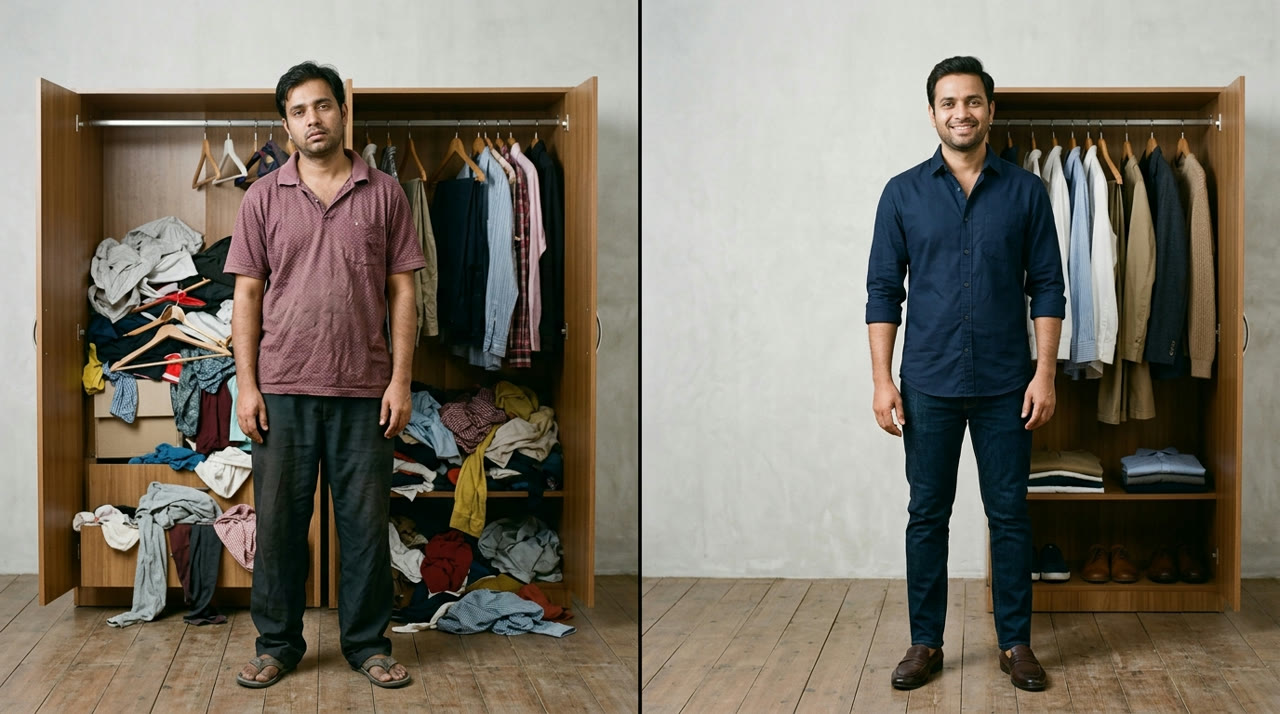
You finally decided to fix the wardrobe. Maybe it was a new job, a friend's wedding season filling up the calendar, a break-up, or just one more Monday morning staring into a cupboard that's full of clothes and somehow has nothing to wear. So you went shopping — properly, this time. A few weeks later the bags are unpacked, the card statement has landed, and half of it is sitting at the back of the cupboard, tags still on.
The problem was never the money. It's how it got spent — panic-bought in one late-night binge, chasing whatever's trending, ignoring fit for a size label, buying for a life that isn't quite the one you live, skipping the tailor to save a few hundred rupees, and doing all of it with no real plan. Any one of these turns a rebuild into an expensive false start. Most wardrobes carry all six at once.
This is the fix: six mistakes that quietly drain a wardrobe-rebuilding budget in India, and the plan that gets it right the first time — on a realistic budget, without a single panic-buy.
Mistake #1: Panic-buying the entire wardrobe in one weekend
It usually starts with a trigger — a wedding invite, a new job, a break-up, or a sale notification landing at exactly the wrong moment. You open Myntra or Ajio at 11pm, and by 1am the cart has fourteen items in it. Nothing in it was checked against what you already own or tried against anything else in the cart — it just felt good to finally be "doing something" about the wardrobe.
This is the costliest mistake in a wardrobe rebuild, because a rushed cart rarely produces outfits, only items. Fourteen pieces bought in one sitting usually make three full outfits — the rest sits in the cupboard past the return window.
- Give every big purchase 48 hours before you check out. If you still want it after two days, it was a decision. If you don't, it was a mood.
- Never shop a sale without a list. End of Reason Sale and Big Billion Days are built to make "35% off" feel like the reason to buy, not whether you need it.
- Buy in outfit-sized batches, not category by category. A top and a bottom you know will be worn together beats six shirts and zero trousers that go with them.
Mistake #2: Chasing every trend instead of building a base
Cargo trousers, oversized tees, Y2K logos, the latest co-ord set — trend pieces are fun, and Instagram makes them look essential. But a trend has a shelf life of a season or two before it starts reading as "that thing I bought last year," while a well-cut white shirt or a navy blazer looks exactly as sharp in five years as it does today.
The mistake isn't buying trend pieces. It's letting them become the majority of the wardrobe instead of the seasoning on top of a base that doesn't age.
- Run an 80/20 split. Roughly 80% of spend on classics that work for years — oxford shirts, chinos, a blazer, leather derbies — and 20% on the trend pieces you actually love this season.
- Buy trend pieces cheap, buy classics well. A ₹799 trend tee that's out of style by next year is fine to buy cheap. A shirt or trouser you'll wear every week for years is where better fabric and cut earn their price.
- If you can't picture wearing it in two years, it's a trend, not an investment — budget for it accordingly.
Get all of this decided for your exact features
Everything here is general. Your TheGent Style Report turns your own face shape, body type and skin tone into a personal system — 2 hairstyles, fit rules, a 23-colour palette and 28 outfits built for you, in 48 hours.
Get your Style Report →Mistake #3: Ignoring fit and buying by size label alone
Indian sizing isn't standardised. A "medium" in Uniqlo, a "medium" in a mall brand and a "medium" in a local export-surplus store can differ by two inches at the chest. Buying on autopilot — same size, no trial, no second look in the mirror — is how men end up with a cupboard full of technically-your-size clothes that all fit slightly wrong.
Fit is what separates expensive-looking from merely expensive. A ₹1,500 shirt that actually fits your shoulders and tapers at your waist will look sharper than a ₹5,000 shirt bought two sizes off. This is also where rebuild budgets quietly leak — money spent on brand and price point instead of on how to dress for your body type, which costs nothing to learn and changes how everything else you own looks.
- Try before you buy, every time — online or in store. A size that fit six months ago may not fit now.
- Know your actual shoulder-to-waist relationship before you shop, not after the third return.
- Tailoring is part of the fit fix, not a separate step — more on that below.
If you'd rather skip the trial and error, TheGent's Style Report reads your actual body type, face shape and skin tone, and hands you the fit rules for your exact frame in 48 hours — so every rupee after that goes toward something that was always going to fit.
Mistake #4: Buying for the life you wish you had
This one is quieter but just as expensive. A blazer bought for "networking events" that never happen. Resort wear for the one Goa trip a year. Three sets of gym wear for a membership used twice. A stack of going-out shirts bought for a social life that's mostly a Zomato order and a film at home.
None of it is wrong to own — the problem is proportion. If 70% of your actual week is office-casual or work-from-home, but 70% of the budget went to occasion-wear you touch four times a year, the wardrobe will always feel like it's missing something.
- Audit your actual last 30 days, not your ideal ones. Count office days, WFH days, one-off events and everything between.
- Spend where you live, not where you'd like to be seen. If most weeks are desk-and-commute, that's where the budget belongs.
- Buy occasion-wear last, and only for occasions already on the calendar — not hypothetical ones.
Mistake #5: Skipping the tailor to save money
Indian men will spend ₹4,000 on a shirt and never once think to spend ₹400 getting it altered. That's backwards. Off-the-rack sizing — Indian or international — is cut to one generic block shape, and almost nobody's shoulders, waist and height match that block exactly.
A ₹300–800 tailoring pass on the waist, sleeves and length does more for how a garment looks than any amount of extra spend on the brand. It's the single highest-return purchase in a wardrobe rebuild, and the one most men skip, because it feels like an extra errand rather than part of the purchase itself.
- Budget tailoring into every purchase, not as an afterthought — treat it as 10–15% on top of the sticker price.
- Find one tailor you trust and keep going back — consistency in fit matters more than convenience.
- Trousers and shirts benefit the most. Waist taper, sleeve length and shirt length are the three fixes that change a garment most for the least money.
Mistake #6: Rebuilding with no plan, no colour system, no budget split
The most common version: one good shirt this month, trousers next month, a jacket the month after — each reasonable alone, none of them talking to each other. Eight months later: eight decent pieces, maybe three outfits, because nothing was chosen against a plan.
A wardrobe rebuild needs what a renovation does — a plan before the spending starts, not after. That means a base colour palette so new pieces combine by default, and a budget split across categories instead of spending wherever the next sale happens to land.
- Pick 2–3 neutrals and 1–2 accents as your base — ideally from the colours that suit your skin tone, not just what's on the mannequin — and buy inside that palette for a season.
- Split the budget by category — tops, bottoms, footwear, layering and a tailoring reserve — instead of one lump sum spent on whatever's in front of you.
- Write the gap list before you shop, not while you shop. "One more versatile top for weddings" beats browsing and hoping something jumps out.
How to rebuild your wardrobe the smart, cost-effective way
Fixing all six mistakes is really one shift: slow down and add structure. Here's the sequence that rebuilds an Indian wardrobe properly without overspending.
- Audit first, buy second. Empty the cupboard, sort into keep, tailor and donate — the real gap list is almost always smaller than it feels.
- List your real occasions for a typical month — office days, WFH, one wedding season, festive functions, dates — and weight the budget toward whichever eats the most days.
- Buy the neutral foundation first: a white and a light-blue shirt, one navy or stone trouser, a pair of leather derbies or loafers, one blazer or overshirt. Everything else builds outward from these.
- Tailor as you go, not in a batch six months later — an untailored piece sitting in the cupboard is money not yet spent well.
- Spread the rebuild over 6–8 weeks, not one weekend — enough time to test combinations before the next purchase, instead of letting a sale dictate what you buy.
Done this way, a full rebuild — foundation, layering, footwear and tailoring — is realistic for roughly ₹20,000–35,000 over two months, not what a single panic-buy weekend quietly becomes. Keep going with the habits that make men stylish once it's done, and the wardrobe stays working instead of sliding back into the same six mistakes.
Know your Style DNA before you spend another rupee
Every fix above will save real money and stop a rebuild from working against itself — none of it costs more than a bit of planning. What it can't do is tell you, specifically, which colours suit your skin tone, which fit suits your exact frame, or which two or three pieces do the most work for your face shape and build.
That's the gap TheGent's Personal Style Report closes. For ₹1,999, it reads your actual face shape, body type and skin tone — not a guess in a changing room — and turns it into a complete Style DNA: 2 hairstyles and a grooming guide, fit rules for your exact frame, a 23-colour palette, and 28 outfit visuals across 7 categories, delivered in 48 hours and kept in the app for life. Over 4,000 Indian men have used it, rated 4.9/5.
A wardrobe rebuilt on guesswork gets rebuilt again in two years. Get your Style Report and spend the next round of money only on what was always going to work.
- Most wardrobe-rebuild money is lost to panic-buying, trend-chasing and having no plan — not to needing better clothes.
- Fit and tailoring matter more than brand or price; a ₹300–800 tailoring pass outperforms most 'upgrade the brand' spending.
- Buy for the life you actually live — audit your real month before buying for weddings, gyms or dates that rarely happen.
- A base of 2–3 neutral colours and a category-wise budget turns purchases into outfits instead of unrelated items.
- Spread the rebuild over 6–8 weeks with a plan; a realistic Indian budget is ₹20,000–35,000, less than most panic-buy weekends.
Frequently asked
A realistic capsule rebuild — foundation shirts, trousers, one blazer, footwear and tailoring — runs roughly ₹20,000–35,000 built up over two months. A panic-buy weekend chasing trends often costs more for far fewer usable outfits.
Buying without a plan. A rebuild done purchase by purchase, with no base colour palette or category budget, produces a cupboard full of items that don't combine into outfits, however good each one is on its own.
Yes, more than almost anything else. A ₹300–800 tailoring pass does more for how a garment looks than upgrading the brand, and it's the cheapest way to make an existing wardrobe look intentional again.
Spread it over 6–8 weeks rather than one weekend. It gives you time to test new pieces against what you already own, and stops a sale from deciding your wardrobe for you.
No — audit first. Most men already own more usable pieces than they realise, so sort into keep, tailor and donate before buying anything new, and let the rebuild fill real gaps instead of duplicating what already works.
Match purchases to your real month, not an ideal one. Count actual office days, WFH days and events from the last 30 days, and weight spending toward that instead of occasions that happen once a year.