 The
The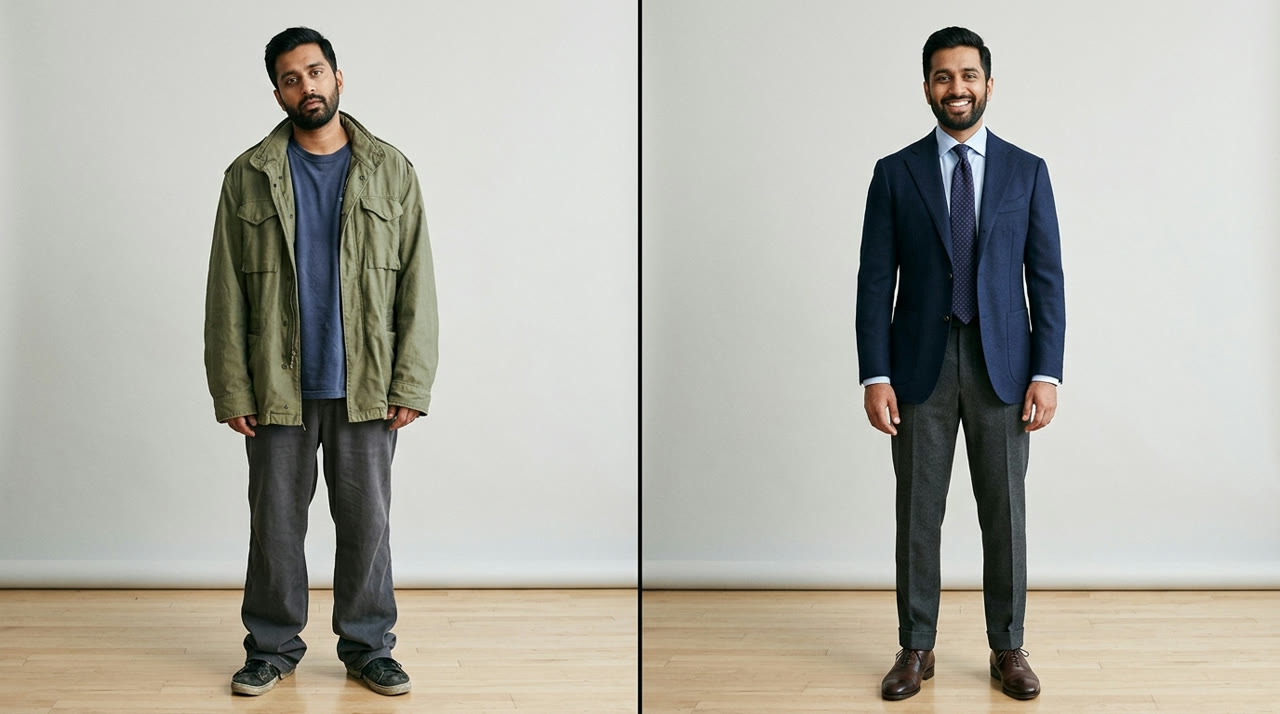
You buy the shirt that looked sharp on the model, and on you it hangs wrong — loose at the chest, tight across the stomach, or so shapeless it could belong to anyone. You size up for your shoulders and the waist balloons. You size down for your stomach and the buttons pull. It isn't your taste that's off.
It's proportion. Off-the-rack sizing in India is cut to one generic block shape, and Indian men don't come in one shape — slim desk-job frames, broad gym-built shoulders, a fuller middle that shows up after 30, or a shorter frame that most "just wear a medium" advice never accounts for. How you dress for your actual body type is a different question for each of these.
This guide answers it. Below are the concrete fit rules — cuts, collars, proportions and fabrics that survive Indian heat — for every major male body type, so you know exactly what to buy, alter or avoid instead of guessing in a changing room.
Why your clothes fit the model, not you
Most style advice online is written for a body that doesn't exist — tall, athletic, Western proportions, shot under studio lighting. Follow it literally and you copy an outfit instead of building a fit.
Fit is not about taste. It's the relationship between your shoulders, chest, waist and height. Two men in the identical navy blazer, same size label, can look completely different — sharp on one, borrowed on the other. The blazer didn't change; the proportions underneath it did.
The fix isn't a bigger wardrobe. It's knowing your actual body type and applying the handful of cut, collar and proportion rules that work for it, every time — regardless of what's trending.
Find your body type in under a minute
Stand in front of a mirror in a fitted tee, or check your last few photos. You're looking for where your body is widest — shoulders, waist or hips — and how much definition sits at your middle.
- Slim or lean: shoulders, chest and waist are close in width, so clothes hang rather than sit.
- Average or rectangle: balanced shoulders and waist, no strong taper either way. The most common Indian build, and the most forgiving once the fit is right.
- Broad or athletic: shoulders and chest visibly wider than the waist — the classic "inverted triangle."
- Heavier or fuller middle: most of the weight sits at the stomach, waist wider than chest and shoulders.
- Short: under roughly 5'6" / 168cm, at any build — proportion rules that stack on top of whichever type above fits you.
Once you know which one fits, the rules below are specific and permanent. If you'd rather skip the mirror-guessing, TheGent's Style Report reads your actual build, face shape and skin tone, and hands you the exact fit rules in 48 hours.
Get all of this decided for your exact features
Everything here is general. Your TheGent Style Report turns your own face shape, body type and skin tone into a personal system — 2 hairstyles, fit rules, a 23-colour palette and 28 outfits built for you, in 48 hours.
Get your Style Report →The slim or lean build
The problem isn't being thin. It's clothes with no structure, which make a lean frame look smaller instead of sharp.
- Go tailored, not skinny. Skinny fits cling to nothing and read try-hard on a thin frame; a tailored cut that follows your shoulders and tapers gently to the waist looks sharp instead.
- Build the shoulder line. Structured blazers and overshirts with a defined shoulder seam add width where you need it, and double as a layer for visual mass without extra heat. Avoid sloping raglan sleeves.
- Pick collars with some spread. A spread or semi-spread collar opens up the neck and adds width to a narrow face and frame. Skip small button-down collars — they disappear on a slim build.
- Choose texture over flat fabric. Waffle knit, corduroy, chambray and brushed cotton add visual bulk that plain flat cotton doesn't.
- Tuck in and anchor with a belt. Defining the waist gives the eye a reference point — leaving everything untucked reads shapeless.
The average or rectangle build
This is the most common build among Indian men, and the most misleading, because "average" doesn't mean "anything fits." Off-the-rack Indian sizing runs generous through the body and narrow at the shoulder, so even a balanced frame looks boxy in unaltered clothes.
- Tailor everything, even basics. Take shirts and trousers to a local tailor for a waist taper and sleeve adjustment — it typically costs ₹300–800 a piece and does more than any purchase.
- Keep top and bottom proportional. A rectangle build can wear looser or slimmer, but not both at once — an oversized shirt over skinny trousers breaks the line.
- Create shape at the waist, not the shoulder. A slight taper at the waist on shirts and jackets is what turns "fits okay" into "fits well" — you're defining what's already there.
- This build carries trends well. Wider trousers, boxier jackets, oversized layering — a rectangle frame has room to experiment that other builds don't. Just keep one half of the outfit fitted while the other runs loose.
The broad or athletic build
Shoulders and chest wider than the waist is increasingly common in Tier-1 India as gym culture goes mainstream, and it comes with a specific fit problem: shirts that fit the chest are baggy at the waist, and shirts that fit the waist strain at the chest buttons.
- Buy for the chest, tailor the waist. Size up for shoulders and chest, then get the waist taken in. Never buy tight through the chest to "fit the body" — a straining button line looks unkempt.
- Look for cotton-lycra and stretch weaves. Most Indian shirt brands now offer stretch-cotton options that move with a broader chest without sizing up, and breathe better than you'd expect.
- Go straight or gently tapered on trousers, never skinny. Skinny trousers under a broad top exaggerate the imbalance; a straight leg or gentle taper balances the frame instead.
- Choose open necklines over crew. A spread collar or open polo avoids boxing in the neck further; crew necks and high round collars add bulk where you already have it.
- Pick single-breasted jackets with waist suppression. A jacket cut close through the body and structured at the shoulder flatters an athletic frame more than an oversized one.
The heavier build or fuller middle
Most weight gain in Indian men past 30 lands at the stomach first — desk jobs, travel-heavy food, a slowing metabolism. The common mistake is going looser to hide it, which does the opposite.
- Aim for room without bagginess. There's a middle ground between clinging and tent-like: enough room to skim the body without pulling at the buttons, and a jacket with structure rather than an oversized drape.
- Favour vertical lines and solid colours. Vertical stripes, plain fabrics and an open jacket worn unbuttoned draw the eye down rather than across; horizontal stripes and large chest graphics do the opposite.
- Go flat-front and mid-rise on trousers. Pleats add bulk exactly at the stomach. A mid-rise, flat-front trouser that sits at the natural waist — not below the belly — holds its line all day.
- Get the shirt length right. A shirt cut too short un-tucks itself by lunchtime. Go slightly longer, or wear a straight-hem shirt untucked at the correct length — mid-fly, not mid-thigh.
If you carry weight around the middle specifically, this guide goes deeper on the exact cuts and layering for it. If it's more through the chest, our guide on how to minimise a fuller chest covers those fixes without switching to oversized clothing.
The short build
Under roughly 5'6" / 168cm — a genuinely common Indian male height, not an outlier — the issue isn't the clothes, it's the break points. Any garment that adds a horizontal line in the wrong place eats into your height.
- Go high-rise with minimal break. Trousers that sit at the natural waist with no break, or the slightest one, elongate the leg line. Fabric pooling at the ankle is the biggest height-shrinker in Indian menswear.
- Dress tonally. Keeping top and bottom in the same or closely related colour removes the visual "cut" at the waist that shortens you. Navy-on-navy reads taller than navy-on-black with a hard contrast.
- Keep jacket length short. A jacket or overshirt that ends at the hip, not mid-thigh, keeps the leg line long — oversized layering is the fastest way to look swallowed by your own outfit.
- Choose sleeker shoes. Low-profile shoes and trainers read cleaner than chunky soles. A slight heel — even 1–1.5cm on a derby or Chelsea boot — helps and isn't noticeable.
Fabric and cut rules for Indian heat
Every rule above still has to survive a Delhi summer or a Chennai monsoon — the sharpest cut in the wrong fabric feels wrong within the hour.
- Cotton and linen first, always. Pure cotton, linen and linen-cotton blends breathe in a way polyester and viscose never will, whatever the brand tag promises about "cooling tech."
- Structured doesn't mean heavy. Oxford cotton, cotton poplin and seersucker hold a sharp line without trapping heat — you need the right weave, not a thicker one.
- Dress for two climates a day. Indian offices run cold on AC; the street outside doesn't. A structured overshirt you can remove is more useful than a heavy one you can't.
- Monsoon-proof your basics. Darker washes and quick-dry fabrics handle sudden rain better than pale linen. Canvas or rubber-soled shoes beat suede from June to September.
None of this needs an expensive wardrobe. Uniqlo, Marks & Spencer and H&M carry well-cut basics at accessible prices, and Indian tailoring means ₹300–800 turns any off-the-rack piece into a properly fitted one.
Know it for certain, not for guess
Everything above gets you most of the way there, and mirror checks and proportion rules are genuinely useful, free, and yours to keep. What they can't do is tell you, with certainty, which category you actually fall into, or catch the in-between cases most men really are.
That's the gap TheGent's Personal Style Report closes. For ₹1,999, it reads your actual body type, face shape and skin tone — not a mirror guess — and turns it into a full Style DNA: fit rules built for your exact frame, a 23-colour palette for your skin tone, and 28 outfit visuals across 7 categories, delivered in 48 hours and kept in the app for life. Over 4,000 Indian men have used it, rated 4.9/5.
Fit fixes your silhouette. The colours that suit your skin tone are the next lever, and matter just as much. Get your full Style Report and stop guessing at both.
- Fit is decided by proportion, not trend — learn your body type once and the rules stay useful for life.
- Slim builds need structure and layering; broad builds need room in the chest with a tailored waist; heavier builds need vertical lines and room without bagginess; short builds need minimal break and tonal dressing.
- Off-the-rack Indian sizing is generic — a ₹300–800 local tailoring pass fixes more than any new purchase.
- Cotton and linen beat every synthetic "cooling tech" fabric for actual Indian heat and humidity.
- Body type is one part of your Style DNA — skin tone and face shape decide the rest of what genuinely suits you.
Frequently asked
Check where you're widest in a fitted tee — shoulders, waist or hips — and how much definition you have at the middle. Most Indian men fall into slim, average, broad/athletic or heavier builds, with height as a separate factor layered on top.
Slim and average/rectangle builds are most common under 30. A fuller midsection becomes more common after 30 due to desk jobs and diet, while broader, athletic builds are rising fastest in metro cities on the back of gym culture.
Clothing doesn't change your body, but it changes what the eye reads first. Proportion, line and colour placement genuinely shift how broad, tall or lean you appear — that's optics, not illusion, and it works consistently once you know your type.
Cotton, linen and linen-cotton blends breathe better than any synthetic blend, whatever the fabric technology claims on the label. Oxford cotton and poplin give you structure without the heat of heavier weaves.
Yes. Indian off-the-rack sizing is a generic block shape, not your shape. A ₹300–800 alteration at a local tailor for the waist and sleeves does more for how clothes fit than upgrading the brand.
Yes. Most men shift toward a fuller midsection through their 30s and 40s as metabolism slows, so it's worth reassessing every few years instead of still dressing for the build you had at 25.