 The
The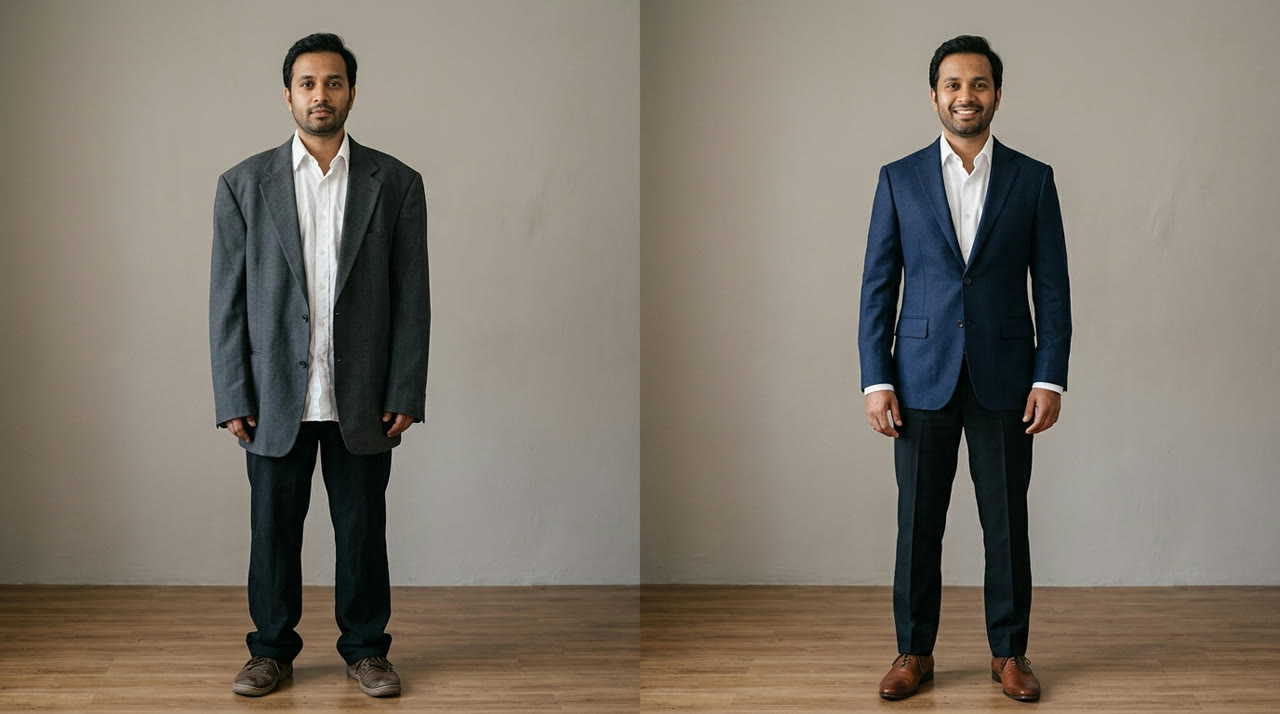
You try on a jacket in your usual chest size, and something is off before you even check the mirror — the shoulders extend past where your arms start, the sleeves creep over your knuckles, and the hem drops closer to mid-thigh than it should. None of this is your fault, or your build's fault. The jacket was drafted for a frame taller and broader than yours, and every size on the rack is a small step up from that same block.
Short and slim compound each other faster than either alone. A tall, slim man can size down and let length sort itself out. A short, broad man has the shoulders and chest to fill the extra fabric. A short, slim frame — common among Indian men in their 20s and early 30s — gets the worst of standard sizing: too much room everywhere, and every extra inch reads as a borrowed suit, not a sharp one.
None of it gets fixed by sizing up or down. It's fixed by knowing the seven proportions that actually decide how a jacket sits on a short, slim body — length, shoulder, sleeve, button stance, lapel, waist and vent — and which of those off-the-rack India gets right, and which one only a tailor can.
Why off-the-rack jackets fight a short, slim frame
Indian retail blocks — the base pattern a brand grades every size up and down from — are typically drafted around a 172–175cm frame with roughly a six-inch difference between chest and waist measurement (tailors call this the drop). A short, slim build usually has a smaller chest and a bigger drop — eight to ten inches is common, because the waist stays narrow while the block assumes it won't. Buy the chest size that fits your shoulders, and the waist, length and sleeve all arrive sized for a different man.
A t-shirt has almost no structure to get wrong; a jacket has seven separate ones, and Indian sizing charts optimise for the average of all of them, not your specific combination — why a size that's fit you fine in shirts for years can still land wrong for a wedding or an interview.
Buy for your shoulders first, and plan to alter everything else — it's the one proportion a tailor can't cheaply fix, so it has to be right at the point of purchase. This sits inside the wider question of how to dress for your body type — a jacket is simply the highest-stakes garment to get wrong, because structure hides nothing.
Jacket length: the one change that lengthens your legs
Length is the single biggest lever for a short frame, and the one most men get wrong simply by accepting whatever hem arrives with their chest size.
The standard test still holds: let your arms hang naturally and curl your fingers — the hem should end roughly where your thumb knuckle sits. For a frame under roughly 5'6" / 168cm, that point falls half an inch to an inch shorter than what a store associate will pull for your chest size, because the standard block adds length for a taller average height.
A hem is a horizontal line, and any horizontal line placed low on the body cuts the leg short beneath it. Raise it even slightly and the eye reads more leg below the jacket, which reads as more height overall — the same logic that makes a high-rise trouser work. It's also the cheapest, most reliable fix on this list: nearly every tailor in India can take up a hem in a single visit, often while you wait.
Short and broad or muscular rather than slim? The length rule still applies, but the shoulder and chest maths changes — see our guide on how short, muscular men should dress for that version.
Get all of this decided for your exact features
Everything here is general. Your TheGent Style Report turns your own face shape, body type and skin tone into a personal system — 2 hairstyles, fit rules, a 23-colour palette and 28 outfits built for you, in 48 hours.
Get your Style Report →Shoulder fit: the seam that decides everything else
The shoulder seam should sit exactly at the point where your shoulder ends and your arm begins — no further. Go past that point and you get a dropped or extended shoulder, which reads as borrowed bulk on a slim frame rather than presence.
- Watch for divots or bunching at the sleeve head. If the fabric dents or creases where the sleeve joins the shoulder, the jacket is too big there — no amount of tailoring elsewhere corrects it properly.
- Skip heavy padding. Structured, padded shoulders add width in exactly the direction a slim frame doesn't need filled. Light or half-canvas construction follows your natural shoulder line and looks considerably more current than the boxy, heavily padded blazers still common in Indian formalwear stores.
- Treat this as non-negotiable at purchase. Re-cutting a shoulder is expensive, sometimes impossible, and rarely worth attempting — if the shoulder is wrong, the jacket is wrong, whatever the rest of the fit looks like.
Sleeve length and the cuff you should always show
Sleeves should end at the wrist bone, showing a quarter to half inch of shirt cuff underneath. Run past that and the jacket reads borrowed; a sleeve that covers the hand entirely is the fastest way to shrink your own arm length, and with it, your overall proportions.
On a slim arm specifically, ask for the sleeve to be tapered along the forearm rather than left cylindrical. A straight sleeve cut for an average arm bunches at the wrist on a thin one, adding bulk exactly where you don't have any to begin with.
This is genuinely good news: sleeve shortening is one of the fastest, cheapest jobs any tailor in India handles, and one most men already know to ask for on shirts but forget to ask for on jackets.
Button stance and lapel width: keep the vertical line unbroken
The button stance — where the top button sits relative to your natural waist — controls how long your torso reads before the eye reaches your waistline. A higher stance stretches that line; a lower one shortens it.
- Go two-button, single-breasted, as your default. It places the button just above your natural waist, which flatters a short torso far more reliably than any other configuration.
- Be careful with double-breasted jackets. The extra fabric and lower button stance can add width and cut height on a compact frame — striking on the right body, risky on yours until the basics are second nature.
- Keep the lapel proportional to your actual chest, not to what's trending. A narrow-to-medium notch lapel, roughly 6.5–8cm wide, suits a slim, short build. Wider lapels overwhelm a narrow chest; anything much under 6cm can look flimsy rather than deliberate.
Waist suppression: give a slim frame actual shape
Waist suppression is how much a jacket tapers in from the chest to the waist. Off-the-rack Indian blazers are cut with minimal suppression by default, because the same block also has to fit fuller torsos in that size run — which leaves a genuinely slim chest swimming in extra fabric through the sides and back, even when the shoulders and chest fit fine.
This is the alteration that does the most for the least money. Taking in the side seams to create a close but not tight taper through the waist is what turns a boxy, off-the-rack blazer into something that looks made for you — because, after this one change, it effectively is.
The benchmark: buttoned, you should be able to slide a flat hand between the jacket and your waist, no more. Any looser and the shape is doing nothing for you; any tighter and you can't sit through a function or a meeting without the button pulling.
Not sure exactly which of these seven proportions your build actually needs corrected? TheGent's Style Report reads your actual body type and hands you the fit rules — jackets included — built for your frame specifically, in 48 hours.
Vents: the detail almost everyone skips past
The vent — the slit at the back hem — affects both how a jacket moves and how it reads visually, and most men never think about it because most Indian off-the-rack blazers only offer one option anyway.
- No vent gives the cleanest possible line and suits a slim frame visually, but restricts movement — awkward if you're sitting through a long function or driving yourself to one.
- Single centre vent is what you'll find on almost every mass-market Indian blazer. Functional and unremarkable, but prone to flaring into an unflattering flap if the seat fits loosely.
- Double side vents are generally the most flattering choice for a short, slim build. Two smaller openings sit closer to the body than one central one, keeping a slimming vertical break on both sides while still moving freely when you sit, drive or dance through a wedding function.
If double vents matter to you, they usually mean going made-to-measure rather than off-the-rack — worth requesting specifically if you're already paying a tailor for the rest of this list.
Off-the-rack vs a tailor: how to actually get this in India
You don't need bespoke tailoring to get most of this right — just a shopping strategy and a tailor's number saved in your contacts.
Off-the-rack, buy for the shoulder and accept that everything else needs work. Slim-fit lines from Raymond, Van Heusen, Blackberrys, Arrow and Peter England run narrower through the body than standard cuts; Zara and H&M blazers are cut closer through the chest too, though length still tends to run long on a short frame — budget for a hem alteration wherever you buy.
- Sleeve shortening: roughly ₹150–400
- Hem and length adjustment: roughly ₹300–600
- Waist suppression, side seams taken in: roughly ₹400–800
Together, usually under ₹1,500 on top of the jacket — more useful than paying extra for a pricier piece worn unaltered.
If you wear jackets often, for work, weddings or interviews, made-to-measure is worth the jump. It fixes length, lapel width, button stance and vents at the point of order instead of correcting a stock block afterwards — typically ₹4,000–12,000 in India depending on fabric and city, and the only route that gets all seven proportions right at once.
Fit is the foundation; once it's right, the colours that suit your skin tone are the next lever worth getting exact. Or skip both guessing games entirely — get your full Style Report and have your jacket proportions, colours and grooming decided for your exact frame, permanently.
- Buy a jacket for your shoulders first — it's the one proportion no tailor can cheaply fix; length, sleeve and waist can all be altered afterwards.
- A slightly shorter hem, ending at your thumb knuckle, lengthens your leg line more than any other single change.
- Off-the-rack Indian blazers are cut for a taller, less-tapered block — budget roughly ₹1,000–1,500 for sleeve, length and waist alterations on almost anything you buy.
- A narrow-to-medium lapel, a higher two-button stance and double side vents all work in the same direction: keeping the vertical line unbroken on a compact frame.
- If you wear jackets often, made-to-measure (₹4,000–12,000) fixes all seven proportions at once instead of fighting a stock block.
Frequently asked
Let your arms hang naturally and curl your fingers — the hem should land roughly where your thumb knuckle sits. For men under 5'6", that's usually half an inch to an inch shorter than what a store will hand you by chest size alone.
Not entirely, but approach them carefully. The extra fabric and lower button stance can shorten and add bulk to a compact frame, so a well-tailored two-button single-breasted jacket is the safer, more flattering default.
Sleeve shortening usually costs ₹150–400, a hem or length adjustment ₹300–600, and waist suppression ₹400–800 at a competent local tailor — together usually under ₹1,500, and it changes how a jacket looks more than a pricier unaltered one would.
Often, yes. Made-to-measure lets you fix length, lapel width and button stance at the point of order rather than correcting a stock block afterwards, typically for ₹4,000–12,000 in India — worthwhile if you wear jackets often for work or events.
The seam should sit exactly where your shoulder ends and your arm begins, no further. It's the one proportion that's expensive or impossible to alter later, so it needs to be correct at the point of purchase even if everything else gets tailored.
Double side vents generally look sharper and slimmer on a short frame, since the two smaller openings sit closer to the body than one central vent. Most Indian off-the-rack blazers only offer a single vent, so double usually means going made-to-measure.