 The
The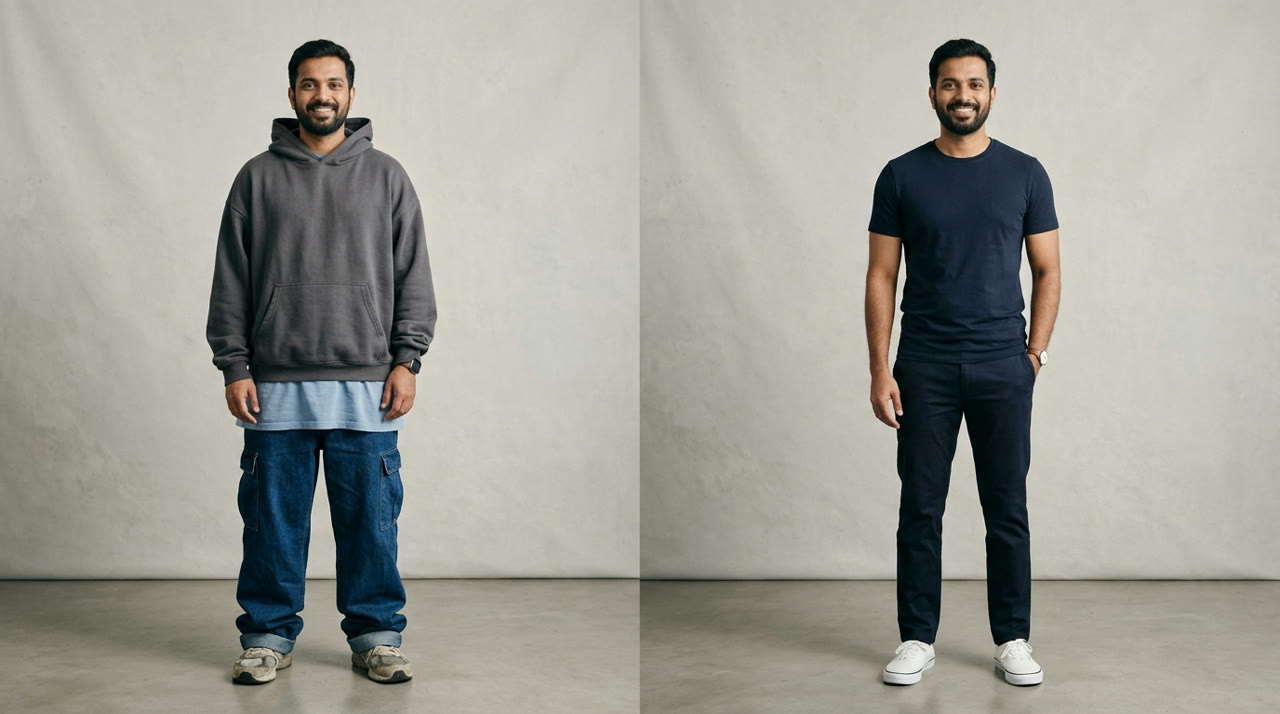
Off-the-rack menswear is cut for two default bodies: tall and lean, or average and soft. If you are short and muscular — broad shoulders, a thick chest, solid thighs, packed onto a frame under 5'7 (170cm) — you fit neither, and you know the fallout: shirts that fit your chest but choke your neck, jackets that fit your shoulders but hang past your knuckles, trousers that fit your thighs but sag everywhere else.
None of this is a flaw in your body. It is a proportion problem, and proportion is fixable — not with looser clothes or a bigger size, but with the right fit, lines and fabric. Get those right and you read solid and sharp, not squeezed.
The rules below are built for Indian retail, Indian tailors and Indian heat, not a Western style column relabelled. Work through them in order — each one stacks on the last.
Get the fit principle right: skim, don't cling
Every rule here sits under one idea: clothes should skim your body, not cling to it or hang off it. Skimming means the fabric follows your shape closely, without pulling at the seams.
Use the two-finger test: button up any shirt and slide two fingers against your chest. Easy in means the fit works; forcing them in means it's too tight — a common trap for men who size up the chest but not the fit style.
- Shoulder seams should sit exactly on the edge of your shoulder bone, not out on your arm.
- Raise your arm forward — fabric across the back should stretch a little, not pull tight.
- Look for athletic fit or muscle fit labelling over plain slim fit, which narrows chest and arms with the waist — the opposite of what a broad chest needs.
If athletic-cut shirts are hard to find, buy for your chest and shoulders and get a tailor to take in the waist. It's the single fix that helps a short-muscular wardrobe most.
Use monochrome and vertical lines to add height
This sits inside the wider logic of dressing for your body type, but height is the lever a short man has to pull hardest. The fastest fix is removing the horizontal break a contrasting outfit creates at your waist.
Dress in one colour, or close tones of one colour, from collar to shoe. Navy-on-navy or charcoal-on-charcoal reads as one long column; a light shirt with dark trousers cuts you in half at the belt.
- Match your belt to your trousers, not your shirt, so it doesn't draw a second line at the waist.
- Favour a visible vertical — a fine stripe, a placket, a seam — over horizontal patterns like wide checks.
- Keep prints small and contrast low; a bold horizontal check on a muscular chest reads bigger, not sharper.
For festive occasions, a bandhgala (Jodhpuri jacket) does this better than almost anything Western — one unbroken column, no waist seam, a collar that lengthens the neck.
Get all of this decided for your exact features
Everything here is general. Your TheGent Style Report turns your own face shape, body type and skin tone into a personal system — 2 hairstyles, fit rules, a 23-colour palette and 28 outfits built for you, in 48 hours.
Get your Style Report →Nail jacket, shoulder and sleeve proportions
A jacket is the hardest garment for a short, muscular man to buy off the rack — the size that fits your shoulders is rarely the length that suits your height. Four measurements matter.
- Shoulder seam: sits exactly on the point of your shoulder bone. Overhang means the jacket's too big — no tailoring fixes a wrong shoulder.
- Padding: skip heavy shoulder padding. You already have the width; extra structure on natural muscle looks costume-like.
- Length: hem lands around the middle of your palm — shorter than standard, since a long jacket cuts your leg line and makes you look shorter.
- Sleeve: cuff shows a quarter to half an inch of shirt cuff. For built forearms, ask your tailor to open the underarm seam, not the forearm, to keep the sleeve clean.
Stick to single-breasted, two-button, notch-lapel cuts — double-breasted adds an overlapping panel across the chest, the last thing you need. Closer to short-and-slim? See our guide to jacket proportions for short and slim men instead.
All this assumes you know your real numbers — shoulder width, chest drop, sleeve length. TheGent's Style Report maps them to your frame in 48 hours, so you shop to a size, not a guess.
Why oversized and baggy works against a muscular build
The instinct to size up is understandable — you want room for your shoulders and chest — but oversized clothing doesn't hide bulk, it relocates it into extra fabric, reading boxier and shorter than your actual body.
Buy to fit what can't be tailored down — shoulders and chest — and let a tailor bring in everything else. A shirt sized for your shoulders and taken in at the waist always looks sharper than one sized for the waist and loose at the shoulders.
- A baggy shirt over baggy trousers erases your waist, the one shape marker that proves you're built, not just big.
- Excess fabric at the hip and thigh adds width exactly where a short frame can least afford it.
- Oversized sleeves and hems add drop at the wrist and ankle, which shortens your arms and legs to the eye.
A well-fitted tailor, for a few hundred rupees a garment, does more for a short-muscular wardrobe than any amount of extra sizing.
Trouser rise and break: the height trick most men miss
Trousers do more damage to a short man's height than any other garment, and almost none of it is about leg length — it's about rise and break.
- Rise: a mid-rise sitting at your natural waist, near the navel. A low-rise dropping onto your hips shortens your leg by starting it lower than it needs to.
- Break: no break to a slight break — the hem just kisses the top of your shoe. A full break bunches fabric at the ankle and chops your leg line.
- Leg shape: a clean straight or slightly tapered thigh beats skinny, which strains on built thighs, or wide-leg, which swallows a compact frame.
With loafers or derbies, a shallow 3-4cm turn-up gives the hem a clean, deliberate stop — it reads taller in photos and in person.
Choose knitwear that skims instead of bulks
Knitwear is where most muscular men undo everything they got right in tailoring — a thick, chunky knit adds bulk exactly where they already have plenty.
Stick to fine-gauge knits — merino wool or fine cotton — rather than chunky cable-knits or heavy wool crew necks. A fine gauge follows your shoulders and chest without adding a visible inch; a thick gauge stacks bulk on top of muscle.
- A V-neck over a collared shirt keeps a clean line to your throat; a crew neck alone on a thick neck can look boxy.
- The same skim-not-cling rule applies — if the knit visibly stretches across your chest, size up and let a tailor take in the sides.
- Layer a fine knit under a bandhgala or blazer for texture, rather than wearing it as your heaviest layer.
Fabrics that handle Indian heat without losing shape
Every rule above assumes fabric that holds its shape through a humid Indian afternoon. Get this wrong and even a perfectly tailored shirt clings with sweat by afternoon, undoing the skim, don't cling principle from earlier.
- Shirts: pure cotton poplin or oxford breathes and holds a crisp line without going limp in humidity.
- Jackets and suits: tropical-weight wool (Super 100s-120s) or a wool-linen blend holds structure through heat far better than heavy worsted wool — ask for half-canvas or unlined construction.
- Linen: breathable, but pure linen creases into a shapeless mess within the hour — a linen-cotton blend gives you both breathability and structure.
- Avoid: polyester-blend wedding-season suiting — it doesn't breathe and clings the moment you sweat.
Brands like Raymond, Blackberrys and Arvind stock tropical-weight wool and linen-cotton blends at accessible prices, and most will alter the shoulder and waist adjustments covered earlier. For how this shifts across the year, see our guide to summer dressing for your body type.
Every rule here works because it's built around your actual shoulder width, chest, height and skin tone — not a generic average. Get your Style Report and TheGent turns those numbers into fit rules, a 23-colour palette and 28 outfit visuals for your frame, delivered in 48 hours for ₹1,999. It was never about hiding the muscle — it's data, applied correctly.
- Fit should skim your frame, never cling — the two-finger chest test is the fastest gut-check.
- Monochrome, vertical-line dressing adds more visual height than any single garment choice.
- A jacket's shoulder seam must sit on your shoulder bone, with minimal padding and a shorter hem.
- A mid-rise trouser with no more than a slight break adds real, visible height.
- Fine-gauge knits and breathable fabrics — cotton poplin, tropical wool, linen-cotton — keep you sharp in Indian heat.
Frequently asked
An athletic or muscle-fit cut rather than a standard slim fit — it keeps room in the chest and arms while tapering the waist. Use the two-finger test at the chest to check you have skim, not cling.
Generally not — the overlapping front panel adds fabric across an already broad chest. A single-breasted, two-button jacket, or a bandhgala for festive wear, is more flattering.
No break to a slight break, where the hem just touches the top of the shoe. A fuller break bunches fabric at the ankle and shortens the leg.
Yes. Thick cable-knits and heavy wool crew necks add visible bulk on top of your build. Fine-gauge merino or cotton knits skim the frame instead.
Pure cotton poplin, tropical-weight wool and linen-cotton blends. Avoid pure linen, which creases into a shapeless drape, and polyester-blend suiting, which clings with sweat.