 The
The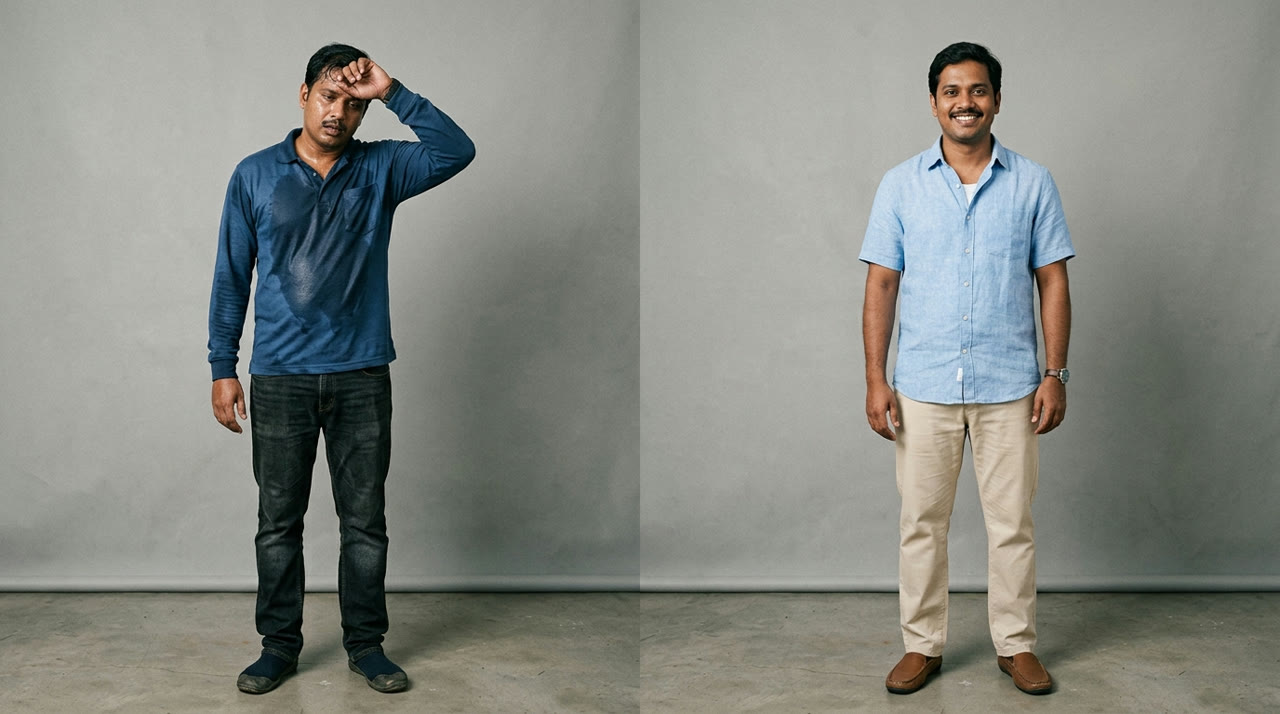
By 10am your shirt is stuck to your back, and by lunch there’s a sweat patch across your chest that the AC vent doesn’t fix. You’ve tried linen that creases the moment you sit down, and loose kurtas that make you look like you’ve given up on dressing well for five months.
The problem isn’t Indian summer itself — you can’t fix 43°C in Delhi or 90% humidity in Mumbai. The problem is that most summer style advice is written for a mild European June, not a body sweating through a commute and an AC that swings 15 degrees from the parking lot. A fit that reads sharp in December can look wrong in May, especially once you factor in whether you run slim, heavier, broad or short.
This guide is the fix: fabric, fit and colour rules for Indian summer, by body type, so you stay cool without looking like you’ve given up.
Why Indian summer needs its own dressing rules
Indian summer is three problems stacked together. North India runs dry and brutal — Delhi and the Gangetic belt regularly cross 42–45°C between April and June. Mumbai, Chennai and Kolkata run cooler on the thermometer but higher on humidity, worse for how clothes feel by 11am. Most Indian offices add a third climate on top — AC at 20°C, then 38°C outside, several times a day.
Clothes chosen for temperature alone miss this. A linen shirt that’s perfect on the street turns crumpled the second you sit in a cold conference room. The right summer wardrobe has to work across both climates in the same day, and with your actual build — not just any build.
That’s what most “10 summer style tips” lists skip. A loose fit that lets a slim frame breathe looks shapeless on a heavier one. The rules below go in order — fabric, fit, colour, then your specific body type.
The fabrics that actually breathe in Indian humidity
Fabric matters more than fit in Indian summer — the sharpest cut in the wrong cloth still leaves you sweat-soaked by 11am. Three fabrics do the real work.
- Linen. The single best fabric for Indian heat — its open weave moves air across your skin instead of trapping it. It creases by design; that’s the fabric working, not a flaw.
- Cotton, but the right weave. Lightweight poplin and voile breathe well, while thick twill or heavy denim traps heat almost like polyester. Under roughly 120 GSM is built for summer.
- Seersucker. The puckered weave holds fabric slightly off your skin, creating airflow, and holds a sharper shape than plain linen — useful for office days.
- Chambray and lightweight Oxford. Cotton weaves with a bit more structure than a plain tee, without the heat of a formal shirt.
Avoid polyester, viscose and rayon blends in peak summer, whatever the tag promises about “cooling technology” — synthetic fibres move sweat around instead of wicking it away. Uniqlo, H&M and FabIndia all stock accessible linen and lightweight cotton.
Get all of this decided for your exact features
Everything here is general. Your TheGent Style Report turns your own face shape, body type and skin tone into a personal system — 2 hairstyles, fit rules, a 23-colour palette and 28 outfits built for you, in 48 hours.
Get your Style Report →Fits that let air move without looking sloppy
The instinct in Indian summer is to size up — buy a size bigger so it doesn’t touch your skin. The fix is ease, not size.
Ease is the small gap between body and fabric — a fist’s width at chest and stomach — that lets air circulate without the garment losing shape. A well-cut shirt with proper ease breathes as well as an oversized one, and still looks tailored.
- Shirts: go regular or relaxed, not slim, not three sizes up — chest and back should skim, not stick, arms raised.
- Trousers and chinos: a straight leg with room through the thigh moves air down your leg; skinny fits trap heat all day.
- Layering: one open layer — an unbuttoned overshirt or linen shirt over a tee — finishes the look without adding heat, since air moves between layers.
- Untucked, on purpose: a shirt with a straight hem, untucked at the right length — mid-fly, not mid-thigh — moves more air than tucked in.
Get this right and your summer wardrobe reads as put together, not “surviving the heat.” Skip the guesswork — TheGent’s Style Report reads your actual body type and hands you the cuts that work on you.
Colours that hide sweat and still look sharp
Light colours reflect heat, which is why every summer guide says wear white and pastels. Almost none mention the trade-off: light colours also show every sweat patch.
The better move for Indian summer is mid-tone, not light-tone. Colours in the middle of the spectrum — neither pale nor black — stay comfortable while hiding sweat marks that would show instantly on white or pale grey.
- Best performers: stone, sand, olive, sage green, mid-blue, indigo washes and warm greys — all hide moisture while reading fresh, not heavy.
- Wear with care: pure white, pale grey and pastel pink show sweat fastest — save them for AC-heavy days, not a commute or outdoors.
- Avoid pure black in direct sun. It absorbs more heat than anything else here, though it hides sweat well — fine for evening, poor for a 2pm meeting.
- Texture does what colour can’t. A slubby linen weave, a subtle check or seersucker’s puckered texture break up the surface so sweat blends in rather than pooling as one patch.
Colour also depends on skin tone — a stone shirt that looks fresh on one man can look washed out on another. That’s a separate question, and the colours that suit your skin tone covers it in depth.
Summer dressing for the slim build
Heat makes a lean frame’s usual problem worse — thin, clingy fabrics like rayon or cheap viscose collapse onto a slim body and make it look narrower. The goal is fabric with enough body to hold shape without trapping heat.
- Choose textured cotton over flat cotton. A waffle-knit polo, chambray shirt or seersucker adds visual width through texture alone, and all three breathe as well as plain cotton.
- Half-sleeve, structured shirts beat T-shirts. A short-sleeve shirt with a proper collar and chest pocket adds shape a slim frame needs; a thin T-shirt alone tends to disappear on a lean build.
- Light layering still works in heat. An open, unbuttoned linen overshirt over a tee adds shoulder width without meaningfully adding heat — it’s one open layer, not a closed one.
- Go relaxed, not skinny, on shorts and trousers. A skinny-fit summer trouser makes a thin leg look thinner; a straight or slightly relaxed cut through the thigh balances the frame.
Summer dressing for the heavier build or fuller midsection
Summer is where “size up to hide it” does the most damage. Oversized fabric clings the moment you sweat, drawing more attention to your midsection than a well-cut piece would.
- Mid-weight linen-cotton blends over pure linen. Pure linen alone can turn soft and cling to a fuller stomach once damp; a linen-cotton blend holds more shape while still breathing well.
- A visible front placket, worn slightly open. It creates a vertical line down your centre — one of the few “hiding” tricks that needs no extra layer.
- Half-tuck over full tuck in peak heat. A half-tuck at the front keeps the shirt looking deliberate without fabric bunching at the waistband on a hot, humid day.
- Stone, olive and mid-blue over white. These hide both sweat and clinging fabric far better than a white shirt will by early afternoon.
For the full fit playbook beyond summer — cut, rise and layering for a fuller midsection year-round — this guide on dressing well with a belly goes deeper.
Summer dressing for the broad or athletic build
A broader chest and shoulders generate more body heat to begin with, and most Indian shirt brands only offer that fit in heavier fabric — the opposite of what you need from May to September.
- Look for stretch-cotton at a summer weight. Most Indian brands now offer cotton-lycra shirts that fit a broader chest without sizing up — check it’s still a lightweight weave, since some stretch cotton runs heavy.
- Short sleeves that end mid-bicep. A sleeve too tight around a bigger arm traps heat with no airflow; one ending mid-bicep with a touch of room fixes this without changing the whole shirt size.
- Open collars over crew necks. A spread collar or a polo with the top button open lets heat escape at the neck, where a broader, muscular frame holds most of it.
- Straight-leg trousers or shorts, not skinny. Skinny fits under a broad top trap heat at the leg and unbalance the frame at once — a straight leg fixes both together.
Summer dressing for the short build
Heat adds one more trap for a shorter frame on top of the usual proportion rules — heavier summer fabric and longer, looser cuts, both meant to help you stay cool, add visual bulk that eats into your height.
- Light fabric, fitted proportion. Linen and lightweight cotton let you stay in a properly fitted shirt and trouser instead of sizing up for comfort — that’s what keeps your line long.
- Shorter hemlines on shirts and overshirts. A shirt or light layer that ends at the hip, not mid-thigh, keeps the leg line uninterrupted, especially without a jacket to break up the silhouette.
- Ankle-length, not cropped, trousers. Cropped summer trousers look breezy on a taller frame but shorten a shorter one further; a full-length trouser with a slight taper is the safer choice.
- Tonal dressing stays cool and elongates. A shirt and trouser in closely related tones — stone-on-stone, olive-on-khaki — removes the hard cut-off at the waist that light-vs-dark creates, and suits summer’s lighter palette.
Get your exact summer rules, not a general guide
Everything above will get any Indian man through summer looking sharper than the size-up-and-hope approach most men default to. Fabric, fit and colour rules travel a long way on their own.
What they can’t do is tell you precisely which category your build falls into, or handle in-between cases — a broad frame that’s started carrying weight, a short build more athletic than slim. That’s what TheGent’s Personal Style Report is built for: for ₹1,999, it reads your actual body type, face shape and skin tone into a complete Style DNA — fit rules, a 23-colour palette, and 28 outfit visuals across 7 categories — delivered in 48 hours, kept in the app for life. Over 4,000 Indian men have used it, rated 4.9/5.
If summer is when your wardrobe struggles most, it’s usually a sign the rest of the year is running on guesswork too. Start with how to dress for your body type for the year-round fundamentals, then get your full Style Report and know exactly what works, every season.
- Fabric matters most in Indian heat — linen, lightweight cotton and seersucker breathe; polyester and viscose don’t, whatever the tag claims.
- The fix for summer heat is proper ease, not a bigger size — a fist’s width of room keeps clothes cool and still tailored.
- Mid-tone colours like stone, olive and mid-blue hide sweat better than white and stay cooler than black — the trade-off most guides miss.
- Each body type needs a different summer adjustment: slim needs texture, heavier needs structured blends over pure linen, broad needs lightweight stretch cotton, short needs fitted proportion over bulk.
- Getting this right head-to-toe depends on knowing your exact body type, not a general category.
Frequently asked
Linen, followed closely by lightweight cotton and seersucker. All three let air move across your skin instead of trapping heat and sweat, unlike polyester or viscose blends.
No — sizing up adds fabric that clings once you sweat and looks sloppy rather than cool. The better fix is proper ease, roughly a fist’s width of room, in a correctly sized garment, not a bigger size altogether.
Mid-tone colours like stone, olive, sage and mid-blue hide sweat marks far better than white or pastels, while staying cooler than pure black. Texture, like a slubby linen weave, helps further.
It’s genuinely functional — the puckered weave holds fabric slightly off your skin, creating airflow that flat cotton doesn’t. It also holds a sharper shape than plain linen, which is useful for office days.
Choose a mid-weight linen-cotton blend rather than pure linen, which can cling once damp. Pair it with a half-tuck and a mid-tone colour like olive or stone rather than white.
Mostly no — breathable fabric and proper ease still matter most. Switch pale linens for slightly darker, quick-drying fabrics and canvas or rubber-soled shoes once the rain starts, since pale fabric shows water stains as badly as sweat.