 The
The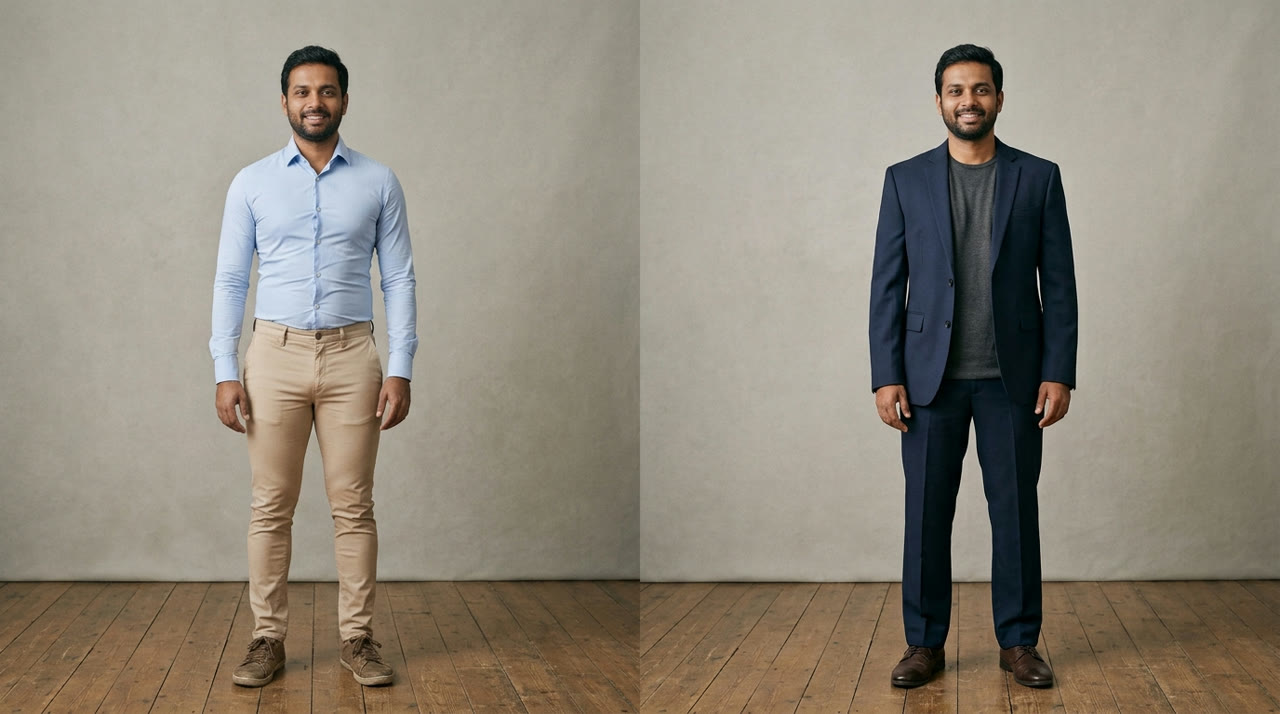
Every pair of trousers you buy fits at the waist and fights you everywhere below it — snug across the seat, tight through the thigh, either straining at the button or gaping open the moment you size up. Shirts sit fine on the shoulder but somehow still look like they're pulling at the hip. And you've probably been told to just 'work on your upper body,' as if six months of gym sessions can substitute for buying clothes cut for the shape you already have.
This is a pear or triangle build — shoulders narrower than the hips and seat, with most of your width sitting below the waist instead of across the chest. It's a genuinely common frame among Indian men, and it has nothing to do with fitness. No number of squats moves where your skeleton carries width. What changes how you look is proportion: broaden the top half, streamline the bottom half, and let colour do some of the work in between.
This guide covers exactly that — the shoulder structure and layering that adds width up top, the trouser cut and rise that stop emphasising your seat, the colour trick of darker bottoms, and the fabrics that hold their shape through Indian heat instead of clinging to it. No diet, no gym plan — just the rules for dressing the frame you have this week, for the office, a wedding or a first date.
Why Wide Hips Aren't a Weight Problem — They're a Proportion Problem
Most advice for a wider lower half starts with squats and cardio. Skip it — nothing about looking sharp requires narrower hips. It requires an outfit balanced at the shoulder and the hip, because that's the line the eye reads first.
Stand side-on in a mirror and look at your outline rather than the details. If your shoulders are the narrowest point on your body and your hips or seat are the widest, the silhouette reads as a triangle, and a triangle registers as 'wide' no matter your actual waist size. This is one of several common builds — see our guide on how to dress for your body type if you're not sure yours is a pear shape. Fix the proportion instead of the weight: widen the shoulder line, keep the leg straight instead of ballooning at the thigh, darken what's below the waist — and the same body reads as balanced, even athletic.
The whole game is optical: broaden up top, streamline down below, and let darker colour do the rest. Every rule below is one of those three levers.
If you'd rather not guess which adjustments matter most for your exact shoulder-to-hip ratio, TheGent's Style Report maps it to your specific frame instead of a general rule.
Shoulders First: Structured Jackets and Horizontal Detail Up Top
The fastest fix available to you is also the simplest: add structure at the shoulder. A jacket, bandhgala or overshirt with a defined shoulder seam extends your frame at the one point that isn't currently pulling its weight.
- Structured jackets: a blazer or bandhgala with a natural, not heavily built, shoulder pad and a proper seam sitting right at your shoulder bone, not drooping past it, adds width exactly where you need it.
- Horizontal detail up top: chest pockets, epaulettes, a contrast-yoke shirt, a textured chest panel or a spread collar all draw a horizontal line across your shoulders — you want that line at the shoulder, not the hip.
- Layering: an open overshirt or unlined jacket worn over a plain T-shirt adds a second shoulder line on top of your own, reading as broader before anyone's even clocked the rest of the outfit.
Avoid raglan sleeves and dropped-shoulder T-shirts as your only layer — the seam sits near your bicep instead of your shoulder bone, sloping the line down and making the hip look wider by default.
Get all of this decided for your exact features
Everything here is general. Your TheGent Style Report turns your own face shape, body type and skin tone into a personal system — 2 hairstyles, fit rules, a 23-colour palette and 28 outfits built for you, in 48 hours.
Get your Style Report →Trousers: Straight-Leg vs Tapered, and Getting the Rise Right
This is where most men get it backwards. A trouser fitted through the hip and thigh that then tapers hard at the ankle draws a second triangle down your leg — it exaggerates exactly what you're trying to balance.
- Leg shape: choose a straight-leg or gently tapered cut that keeps roughly the same width from hip to hem. A straight line down reads leaner than a taper that balloons at the thigh and pinches at the ankle.
- Rise: a mid-to-high rise sitting at your natural waist, not below your hip bone. Low-rise trousers place the waistband right at your widest point — the one place you don't want a horizontal line drawn.
- Pockets: flat front pockets sit cleaner than cargo-style or flap pockets at the hip and thigh, which add visible bulk exactly where you're already carrying width.
- Break: a slight break at the shoe elongates the leg line; no break, or a cropped hem, shortens your proportions and puts more visual weight on the hip by comparison.
Skip skinny-fit and super-slim trousers entirely. They're cut to taper from the hip down, and on this build that means strain at the seat and thigh with no give — the fabric pulls and highlights precisely what a straight cut would smooth over.
Darker Bottoms: The Colour Trick That Actually Works
Colour does real optical work, and it's the easiest lever to pull. Dark tones recede — they make whatever they're covering look smaller and further away. Light and bright tones do the opposite: they advance and add visual weight.
- Trousers: keep your bottom half in navy, charcoal, black, dark olive or deep brown. These recede and narrow the hip and thigh line automatically, whatever the cut.
- Tops: wear your lighter or brighter colours up top — a white, sky-blue or pastel shirt, a patterned or textured jacket — where you want the eye drawn first.
- Contrast placement: a light top with dark trousers is the classic combination for this build. Reverse it, dark top with light trousers, and you've put visual weight exactly where you're trying to reduce it.
- Avoid: pastel or light trousers such as beige, cream or light grey, two-tone trousers, and busy prints or contrast stitching at the hip pocket — all of which add width where a plain dark trouser would take it away.
The exact shades worth building a wardrobe around depend on your skin tone as much as your build — worth pairing this with the colours that suit your skin tone once your silhouette rules are sorted.
Top Length and Layering: Where Hems Should Fall
Where your shirt or jacket ends matters as much as how it fits through the shoulder. Get the hem wrong and you either expose the widest point of your hip or drape a tent straight over it.
- Shirts: worn untucked, a shirt should end roughly where your fingers fall at your side. Shorter exposes the seat; longer starts to read as a dress.
- The tuck: a neat tuck, or a half-tuck at the front near the fly, defines your waist as the narrowest point on your torso and creates a clean break before the hip begins.
- Jackets and overshirts: the hem should land at, or just past, your hip's widest point. An inch above it draws a hard line exactly where you don't want one; too long and it reads as a coat.
- Kurtas: the same logic applies in ethnic wear. A straight-cut kurta falling to mid-thigh skims past the hip cleanly, while a kurta that flares at the hem adds width right where you don't need it. Pair it with a straight pyjama or a slim churidar — both work, since the kurta itself covers the hip line.
The rule: nothing should end exactly at your widest point — it should stop well before it or run past it.
What to Avoid Completely
A short list, but breaking any one of these cancels out everything above.
- Skinny-fit or super-tapered trousers and jeans that pull tight across the seat and thigh.
- Low-rise trousers that sit right at your widest point.
- Cargo pants or trousers with flap pockets at the hip and thigh.
- Light or pastel-coloured trousers, especially under a dark top.
- Cropped or waist-length jackets that stop right above the widest point of your hip.
- Dropped-shoulder, raglan-sleeve T-shirts worn as your only layer.
- Baggy, shapeless tops with no shoulder structure — they add bulk without adding width where it counts, so the hip looks wider by contrast.
- Skinny or high-shine belts that draw a hard, bright line right at your widest point.
If you take one thing from this list: anything that adds bulk below the waist without adding structure above it will always work against you.
Fabrics for Indian Heat That Still Hold Their Shape
This is the part most fit advice skips, and it's where good cutting decisions get undone by 6pm in Indian humidity. A fabric that clings once you sweat erases every rule above it.
- Trousers: cotton twill, cotton-linen blends and structured chino fabric hold a straight leg shape without hugging the thigh — enough weight to skim rather than cling.
- Jackets and layers: unlined or half-lined cotton bandhgalas and linen-blend blazers keep the shoulder structure without trapping heat the way a fully lined wool jacket would.
- Avoid: lycra-heavy stretch trousers, thin rayon and tight-knit polyester — all built to hug the body. Pure, unstructured linen drapes beautifully in theory but tends to cling through a humid commute; a linen-cotton blend holds up far better.
- Test it: scrunch the fabric in your fist. If it springs back into shape, it'll hold a straight line through the day; if it stays creased and limp, it'll cling by afternoon.
Accessible options at this weight are easy to find in India — Raymond Ready-to-Wear, Blackberrys and Allen Solly's structured chino lines all stock straight-cut trousers with enough body to do this properly. For the rest of your wardrobe through the hotter months, see our guide to summer dressing for your body type.
Every rule here — shoulder structure, trouser cut, colour, fabric — is exactly what TheGent's Style Report maps to your frame and skin tone. ₹1,999, delivered in 48 hours, yours for life in the app.
- Wide hips on men are a proportion issue, not a weight issue — balance the shoulder line against the hip line.
- Add structure and horizontal detail at the shoulder — a structured jacket, layering or a spread collar — to broaden the top half.
- Choose straight-leg trousers at a proper natural-waist rise over skinny or low-rise cuts that taper hard below the hip.
- Keep your bottom half in dark, solid colours and save lighter or brighter shades for the top.
- Structured cotton, linen-cotton blends and chino fabric hold a straight leg shape through Indian heat without clinging.
Frequently asked
It's usually called a pear or triangle build — shoulders narrower than the hips and seat, with most of the width sitting below the waist. It's a common frame among Indian men and comes down to bone structure and fat distribution, not fitness.
Not really — a flare below the knee draws even more attention to width further down the leg. A straight-leg cut that holds a consistent width from hip to hem works better than either a flare or a super-skinny taper.
Yes, but keep it simple. A matte leather belt close in tone to your trousers defines the waist without drawing a hard, bright line at your widest point — skip skinny, shiny or contrast-coloured belts.
Yes — choose a straight or slightly relaxed fit through the thigh rather than a skinny or jegging-style cut, in a dark, rigid denim rather than a stretch-heavy wash. Dark, straight jeans are one of the easiest wins for this build.
Pairing a fitted or tapered trouser with an unstructured, shapeless top. Without width at the shoulder to balance against, the hip becomes the widest point in the outfit by default — the fix is adding structure up top, not just changing the trousers.