 The
The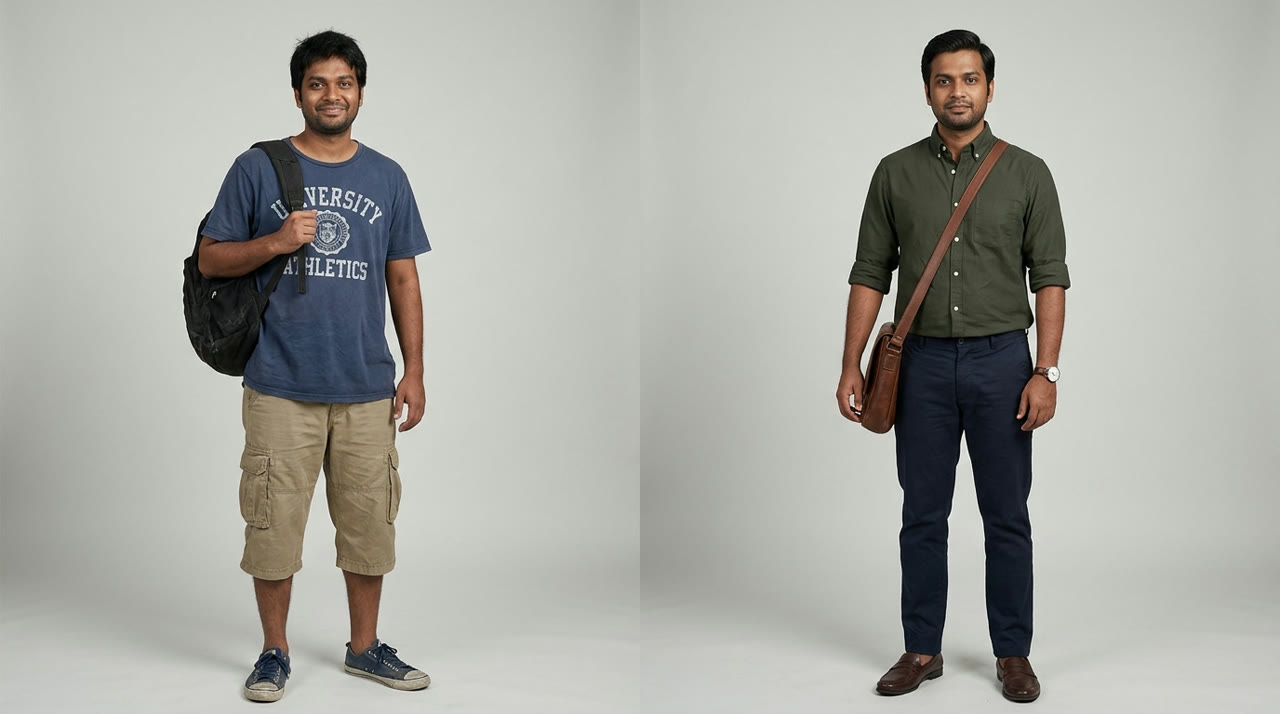
You're getting dressed for a colleague's wedding, or a second date, or the Monday your manager wants everyone back in the office — and your hand goes straight for the same fitted tee and slim-fit jeans that worked when you were 24. Nothing's technically wrong with them. They just don't feel like they belong to the life you're living now.
That's the real problem with dressing sharp in your 30s. It's rarely about age itself — it's that your wardrobe stopped growing while everything else did. More weddings on the calendar, more meetings that actually matter, dates with people who notice details, a body that's carrying weight differently than it did at 22. Meanwhile the wardrobe is still stuck in college mode: graphic tees, ripped denim, ₹399 fast-fashion hauls, and sneakers for every single occasion.
This is the fix. Not "dress older" — dress sharp: fewer, better pieces, an elevated smart-casual formula that works for both the office and the sangeet, fit rules for a frame that's changed, and the grooming habits that finish the look. Built specifically for an Indian man's 30s, not a Pinterest board shot in London.
Why your college wardrobe stops working now
Nothing happened overnight. You didn't wake up on your 30th birthday looking different. What changed is the number of situations your clothes now have to handle — and how much each one costs you if you get it wrong.
At 22, a wrong outfit cost you nothing. At 32, it's the client meeting where you're pitching for budget, the cousin's wedding where relatives are quietly sizing up "how well he's doing," the second date where the first one went well enough to matter. The stakes went up. The wardrobe you built on a student or first-job budget never got the memo.
Add to that a body that's genuinely different — a fuller midsection from a desk job and years of travel food, shoulders that have either broadened from the gym or softened from sitting, hair that's thinning or greying at the temples — and the exact same clothes that fit fine at 24 now fit differently, or not at all. The gap isn't your age. It's that your wardrobe never got upgraded to match the life you're actually living.
The real shift: fewer, better pieces
The instinct in your 20s is to buy a lot, cheap, and often — a new graphic tee every sale, jeans that last one wash season. It made sense on a starting salary. It stops making sense once you can actually afford better.
The shift that changes how you look isn't a bigger wardrobe — it's a smaller, better one. Ten ₹399 t-shirts cost the same as two proper cotton oxford shirts that will outlast all ten, fit better from day one, and work for twice as many occasions.
- Buy five great pieces instead of fifteen forgettable ones. A well-cut blazer, two pairs of properly tailored trousers and a couple of quality shirts will get you through more of your actual week than a drawer full of trend pieces.
- Cost-per-wear beats sticker price. A ₹4,000 shirt worn eighty times a year is cheaper, per wear, than a ₹799 one that pills after six washes and gets binned by August.
- Stop shopping the sale rack for trends. If you wouldn't buy it at full price for a specific occasion, the 40%-off tag isn't a reason to own it.
Get all of this decided for your exact features
Everything here is general. Your TheGent Style Report turns your own face shape, body type and skin tone into a personal system — 2 hairstyles, fit rules, a 23-colour palette and 28 outfits built for you, in 48 hours.
Get your Style Report →The smart-casual formula that works for both worlds
Most Indian men in their 30s live between two dress codes in a single week — a workplace that's gone business-casual, and a social calendar full of weddings, dinners and dates that need more effort than a t-shirt. You don't need two separate wardrobes. You need one formula that flexes.
Elevated smart-casual is that formula: a collared top, a tailored bottom, and one layering piece, in fabrics and colours that mix and match with everything else you own.
- Top: an oxford or linen shirt, a merino or cotton polo, or a well-fitted knit — never a graphic tee for anything beyond the gym or a lazy Sunday.
- Bottom: tailored chinos or a dark, non-distressed jean — straight or slightly tapered, never skinny, never visibly ripped.
- Layer: an unstructured blazer, a bomber, or a good overshirt — it turns a client dinner into a friend's sangeet with one swap of shoes.
- Footwear: leather loafers or derbies for anything with even slight stakes; save sneakers for genuinely casual days, and keep the one pair you do wear clean and current.
Master this formula in navy, stone, white and grey, and the same eight pieces dress you for a Monday stand-up and a Saturday wedding function.
Your 30s capsule wardrobe, item by item
You don't need to replace everything at once. Build this over two or three months and you'll have a wardrobe that covers work, weddings and dates without a single "I have nothing to wear" morning.
- 3 oxford or poplin shirts — white, light blue, and one subtle check, in breathable cotton.
- 2 pairs of tailored chinos — navy and stone/beige, flat-front, ankle-length.
- 1 dark, non-distressed jean — a proper straight or slim-straight cut replaces every ripped or overly skinny pair from your 20s; see our guide on the right jeans for older men if you're not sure which wash and cut to pick.
- 1 navy blazer — unstructured, works over a shirt for weddings and over a tee for dinners.
- 2–3 knit polos or merino tees — solid colours only, no logos across the chest.
- 1 pair of leather loafers or derbies, plus one clean pair of minimal sneakers.
- 1 leather belt and a simple watch — the two accessories that quietly signal effort without saying a word.
That's roughly fourteen pieces that combine into dozens of outfits — the entire point of a capsule wardrobe over a closet full of one-outfit purchases.
Fit rules that change after 30
Here's what most men miss: the size on the label hasn't changed, but the body under it has. A medium at 24 and a medium at 34 can fit completely differently on the same person, and wearing the old size anyway is the biggest reason "good" clothes stop looking good.
Get remeasured at the chest, waist and shoulder rather than assuming your college size still applies. Carrying more through the middle calls for a straight or gently tapered cut with a little room — not a baggy size-up. Broader shoulders from training mean buying for the chest and tailoring the waist in; a local tailor does this for ₹300–800, and it matters more than any brand on the collar.
Tailoring stops being optional in your 30s. The stakes are higher, so the margin for "it mostly fits" gets smaller.
If your build has shifted more than a little since your 20s, our guide on dressing while your body is changing goes deeper on exactly how to adjust cuts and proportions as it keeps evolving. And if you'd rather skip the guesswork entirely, TheGent's Style Report reads your actual body type, face shape and skin tone as they are today — not as they were at 24 — and hands you fit rules built for your exact frame in 48 hours.
Grooming: the other half of dressing sharp
Sharp clothes on ungroomed basics read as effort wasted. In your 30s, grooming needs to catch up the same way your wardrobe does.
- Get a proper haircut every 3–4 weeks, not "whenever it gets long" — and if you're thinning or greying at the temples, ask your barber for a cut that works with it rather than fighting it.
- Start a five-minute skincare routine. A gentle cleanser, a light moisturiser and daily SPF handle Indian heat, pollution and sun far better than nothing at all — this alone changes how put-together you look more than most clothing upgrades.
- Keep the beard deliberate. Fully grown or clean-shaven both work; patchy and undecided doesn't. Trim the lines weekly even if you're keeping the length.
- Nails, brows, and nose and ear hair take two minutes and get noticed the moment they're neglected — especially up close, at a wedding table or across a dinner date.
- Wear a signature scent, applied lightly. One bottle you know well beats three you're unsure about.
Common 30s wardrobe mistakes to avoid
Most men don't get this wrong through bad taste. They get it wrong through habit — wearing what's familiar instead of what fits the life they're actually in now.
- Still wearing your final-year-of-college pieces. If a shirt has outlasted two jobs and a relationship, it's earned retirement, however comfortable it feels.
- Buying the same size out of habit. Assuming a "medium" still fits without trying it on is how most 30s wardrobes quietly stop working.
- Skipping the tailor. A ₹500 alteration does more for how you look than a ₹5,000 impulse buy in the wrong size.
- Wearing sneakers to everything. Comfortable, but it flattens every outfit to the same casual register, wedding functions included.
- Chasing every trend. Cargo trousers and oversized fits can work in your 30s, but only in small doses alongside classics — not as the whole wardrobe.
- Under-dressing for wedding season. Indian wedding functions have their own dress code; a crushed kurta or an ill-fitting suit stands out for the wrong reason.
Rebuilding a wardrobe at this stage comes with its own traps beyond these — our full breakdown of wardrobe-rebuilding mistakes to avoid covers the rest in more detail.
Know it for certain, not by guesswork
Everything above will get a man most of the way there on his own — the formula, the capsule list and the fit rules are genuinely useful without spending a rupee more than you choose to. What they can't do is tell you, specifically, which colours suit your skin tone, which haircut suits your face shape, or exactly how your particular frame should be cut — the details that separate "put together" from "sharp."
That's what TheGent's Personal Style Report is built for. For ₹1,999, it reads your actual face shape, body type and skin tone and turns them into a full Style DNA: 2 hairstyles and a grooming guide built for your face, fit rules for your frame, a 23-colour palette for your skin tone, and 28 outfit visuals across 7 categories — delivered in 48 hours and kept in the app for life. Over 4,000 Indian men have used it, rated 4.9/5.
Your 30s deserve a wardrobe that was actually decided, not inherited from your college years. Get your Style Report and know exactly what to wear next.
- Dressing sharp in your 30s isn't about age — it's about upgrading a wardrobe built for your 20s to match the stakes of your actual life now.
- Shift from buying a lot of cheap pieces to owning fewer, better ones — a tailored blazer and two proper trousers beat ten fast-fashion tees.
- Elevated smart-casual — collared top, tailored bottom, one layering piece — is the one formula that carries you from office to wedding season.
- Your body has changed since your 20s: get remeasured and tailor everything, or the rest of the upgrade won't show.
- Grooming — a regular haircut, a five-minute skincare routine and a deliberate beard — finishes what the wardrobe starts.
Frequently asked
There's no fixed age — it's less about the number and more about your life stage. Once weddings, work meetings and dates start carrying real stakes, usually somewhere in your late 20s to early 30s, your wardrobe needs to catch up.
No. Keep genuinely comfortable basics for home or the gym, but retire anything with graphics, distressing or a fit built for a 22-year-old's frame from your work and going-out rotation.
A well-fitted navy blazer. It's the single most versatile piece — dress it up for a wedding function with a shirt, or down for dinner over a tee — and it instantly elevates whatever it's paired with.
A solid capsule — a blazer, two shirts, two trousers, one pair of quality shoes and tailoring — is realistic for ₹15,000–25,000 built up over two to three months, and most of it will outlast years of cheaper impulse buys.
Yes, both remain wardrobe staples. The shift is in the details: a dark, non-distressed jean instead of ripped skinny denim, and one clean, current pair of sneakers reserved for genuinely casual days rather than every occasion.
A haircut every 3–4 weeks, a beard trim weekly, and a basic skincare routine of cleanser, moisturiser and SPF daily are the minimum that keeps grooming from undercutting an otherwise sharp outfit.