 The
The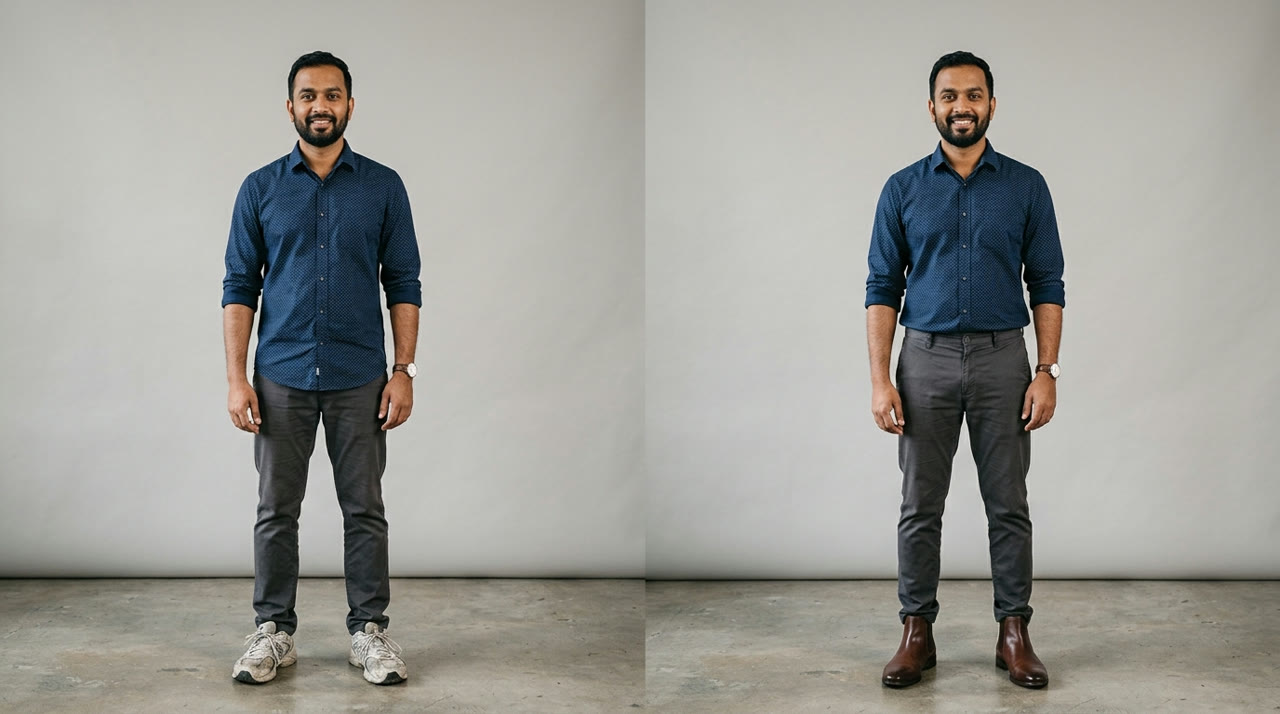
You reach for the same trainers you’ve worn since your second year of college, and something about them feels off next to your work bag — even though nothing about the shoe itself has changed. That mismatch isn’t really about age. It’s about your feet no longer matching the room you’re standing in.
Shoes carry more visual weight than almost anything else you wear, which is why the wrong pair — chunky, scuffed, over-logoed, or simply outdated — ages you faster than a bad haircut. The good news is that getting this right has nothing to do with buying expensive shoes or chasing trends. It’s about matching your footwear to where you actually are in life, to Indian weather, Indian occasions, and Indian budgets.
Here’s exactly how the right shoes for your age should evolve by decade — sneakers versus leather, when to retire the chunky trainers, and the handful of versatile pairs genuinely worth investing in.
Why shoes give away your age faster than your clothes
A jacket can be five years old and still look sharp if it fits well. Shoes are less forgiving. Scuffed toes, cracked leather, or trainers that peaked in 2016 are some of the fastest signals that a man hasn’t updated his eye in a while, even when the rest of his outfit is current.
Shoes sit at the bottom of your outfit, which means they’re also the first thing to show wear and dust from Indian roads. They’re also the one item most men buy once and wear until it falls apart, instead of building a small rotation. That habit — not a number on a birthday card — is what actually ages you.
The real question isn’t “what age should I stop wearing this” — it’s “does this pair still belong in my current life.” A chunky trainer isn’t wrong because you turned 30. It’s wrong when your daily life stopped being about hostel corridors and college fests and started being about client meetings and dinners you’re paying for.
Footwear is one part of a bigger shift. See how to dress for your age for how the rest of your wardrobe should move alongside it.
Your 20s: sneakers are right, but choose them with care
In your 20s, sneakers should absolutely be your default. You’re on your feet more, budgets are tighter, and casual is the correct register for most of your life — college, first jobs, first dates at cafes, weekend plans that come together at the last minute.
The mistake isn’t wearing sneakers. It’s wearing only one kind — an ageing pair of chunky, over-logoed trainers — to everything, including places that call for something cleaner: a cousin’s engagement, a follow-up interview, the first dinner with your girlfriend’s parents.
- Keep: one clean, low-profile white or neutral sneaker — a minimal court-shoe silhouette, not a running shoe — for smart-casual days.
- Add early: one pair of brown or black derbies or loafers. You’ll need them sooner than you think, for interviews, weddings, and the first “nice dinner” invitations.
- Retire: anything with visible cracking, yellowed soles, or a fit you’ve outgrown. In your 20s, this is about maintenance more than upgrading.
Get all of this decided for your exact features
Everything here is general. Your TheGent Style Report turns your own face shape, body type and skin tone into a personal system — 2 hairstyles, fit rules, a 23-colour palette and 28 outfits built for you, in 48 hours.
Get your Style Report →Your 30s: the decade to build a real shoe rotation
This is where most Indian men’s shoe wardrobes should mature, and where most don’t. Your 30s bring a run of weddings — yours, your friends’, your cousins’ — an office role with more visibility, and dates that happen at restaurants instead of canteens. Chunky trainers as your everyday shoe start to read as a decade behind, even when nothing else about you has changed.
This is the decade to retire chunky, dad-sneaker-style trainers as your default shoe — not from your wardrobe entirely, but from anywhere you’re trying to look put-together. Save them for the gym and genuinely casual weekends. Everywhere else, let leather do more of the talking.
If you’ve been putting off dressing sharp in your 30s more generally, shoes are the fastest place to start — they change the read of an outfit more than almost any other single item.
- A proper black or dark brown derby for the office and formal occasions.
- Loafers — penny or plain — for smart-casual dinners, flights, and festive events worn with a kurta.
- One clean, minimal sneaker, kept strictly for weekends and travel.
40s and beyond: comfort meets polish
Past 40, two things change: your feet often need more support after decades of standing, travel and daily wear, and your patience for anything that’s trying too hard drops. Both are good news. The goal now is quiet confidence — shoes that are unmistakably well-made, comfortable enough to forget about, and never shouting for attention.
Chunky trainers are essentially off the table now, except as a deliberate, occasional throwback look, not a default. Comfort-engineered leather — cushioned soles, roomier lasts — matters more here, and brands have caught up: several Indian and international names now build derbies and loafers with genuine all-day comfort, not just style.
- Loafers become your most-worn shoe: reliable for office-casual days, dinners, even flights.
- Keep one sharp black Oxford or derby for weddings, formal events, and the odd bandhgala evening.
- A single clean, minimal leather sneaker (not a running shoe) covers relaxed weekends without looking like you raided your son’s shoe rack.
If you’re rebuilding other parts of your wardrobe alongside your shoes, it’s worth checking the wardrobe-rebuilding mistakes most men make first — shoes are usually the last thing fixed and the first thing noticed.
Four shoes worth investing in, at any age
Regardless of which decade you’re in, the same small rotation covers almost everything an Indian man’s calendar throws at him. Buy fewer pairs, buy them properly, and replace only when they’re genuinely worn out.
- A black or dark brown derby — your office-to-formal workhorse. Choose a clean cap-toe or plain-toe if you only own one.
- Loafers — arguably the most versatile shoe for Indian weather and occasions: chinos, a kurta at a wedding, or trousers at the office on a no-tie day.
- A clean, minimal sneaker — white or a single neutral colour, low-profile, with minimal branding. This is your weekend and travel shoe.
- A pair of mojaris or juttis — genuinely worth owning if you attend Indian weddings regularly. Nothing looks more out of place at a sangeet than trainers under a kurta, and nothing looks more deliberate than well-chosen mojaris.
That’s it. Four pairs, rotated properly, outperform a cupboard full of shoes bought on impulse. Which exact toe shape, sole thickness and colour flatters you most still comes down to your build — that’s precisely what your Style Report maps out for your exact frame, alongside the rest of your fit rules.
Sneakers vs leather: the age-appropriate rule for every occasion
Instead of thinking in terms of age, think in terms of occasion. It’s a more accurate filter, and it’s the one people actually judge you on.
- Office (non-uniform): leather — a derby or loafer, always.
- Weekend outings, first coffee dates: clean, minimal sneakers.
- Dinner dates, second and third dates: loafers read as more deliberate than sneakers, at no cost to comfort.
- Indian weddings and festive events: mojaris with ethnic wear; polished derbies or loafers with a suit or bandhgala.
- Interviews and client meetings: leather, no exceptions, at any age.
The one rule that holds at every age: your shoes should be the cleanest, best-kept item in the outfit, not the most expensive one. A well-polished ₹3,000 derby beats a scuffed ₹15,000 pair every time.
What actually makes sense at Indian price points
You don’t need international price tags to get this right. Here’s roughly where the value sits in the Indian market:
- Clean sneakers: Bata, Liberty and Campus cover ₹1,500–3,500 for simple, minimal styles; Adidas, Puma and New Balance’s classic silhouettes (think Stan Smith or 550-style) run ₹4,000–7,500 and last for years if you keep them off daily rotation.
- Everyday derbies and loafers: Red Tape, Bata Comfit and Liberty sit in the ₹2,000–4,000 range; Clarks, Van Heusen, Ruosh and ID move up to ₹4,000–9,000, with noticeably better leather and comfort.
- Investment leather: once you know you’ll wear a style for years, Clarks’ premium lines or Hidesign push into the ₹8,000–15,000 range — worth it only if you’ll actually rotate and resole them rather than replace them.
- Mojaris and juttis: local artisans and smaller brands start around ₹800–1,500; recognised label options run ₹2,000–4,000.
Spend your money on the derby and the loafer first. They carry the most weight across the widest range of occasions. The sneaker can be the budget pair.
Shoe care that keeps you looking sharp for years
Indian conditions are genuinely harder on shoes than most style advice accounts for — heat, dust, and a proper monsoon that can write off a pair of suede loafers in a single bad evening.
- Rotate, don’t repeat daily. Leather needs 24–48 hours to release moisture and hold its shape, especially given how much most Indian men sweat through a workday.
- Waterproof before the monsoon, not during it. A silicone or wax-based spray on leather buys you real protection; keep suede for the dry months only.
- Use cedar shoe trees, or at minimum stuff wet shoes with newspaper overnight. Humidity is what actually ages leather and causes fungus in Indian closets, not time.
- Polish monthly, not yearly. A five-minute polish extends a pair’s sharp years by a long way, and it’s the cheapest upgrade available to any wardrobe.
- Find a good local cobbler. Resoling costs a fraction of replacing, and it’s a normal, unremarkable habit in India that most men underuse.
Know your shoes for certain, not by guesswork
Everything above will get you most of the way there on its own — the decade markers, the four-shoe rotation and the price guidance are genuinely useful without spending a rupee more than you choose to. What they can’t do is tell you exactly which silhouette, proportion and colour of shoe suits your specific build and skin tone — the details that separate “sensible” from “sharp.”
That’s the gap TheGent’s Personal Style Report closes. For ₹1,999, it reads your actual face shape, body type and skin tone and turns them into a full Style DNA: fit rules for your frame, a 23-colour palette for your skin tone, and 28 outfit visuals across 7 categories — delivered in 48 hours and kept in the app for life. Over 4,000 Indian men have used it, rated 4.9/5.
Your decade tells you roughly where to start. Your actual features decide the rest. Get your Style Report and stop guessing what belongs on your feet.
- Chunky, logo-heavy trainers are a 20s shoe — swap them for a clean, minimal sneaker as your daily default by your 30s.
- Every Indian man can cover most of his life with four pairs: a derby, loafers, a clean sneaker, and mojaris for weddings.
- Leather should do more of the talking as you move from your 20s into your 30s and 40s.
- Indian monsoons are hard on leather — waterproof before the rains, rotate pairs, and use cedar shoe trees.
- Condition beats price: a well-kept ₹3,000 pair looks sharper than a scuffed ₹15,000 one.
Frequently asked
You don’t have to stop entirely, but most Indian men should retire chunky, logo-heavy trainers as their daily shoe by their early-to-mid 30s and replace them with a clean, minimal sneaker for casual days. Sneakers stay appropriate at any age when they’re the right style for the occasion.
For budget sneakers and everyday leather, Bata, Liberty, Red Tape and Campus offer solid value. Clarks, Van Heusen, Ruosh and ID sit in the mid-range with better leather and comfort, and local artisan brands are usually better value than national labels for festive mojaris.
Both work well past 40. Loafers are the easier, more versatile choice for daily smart-casual wear, while a black or dark brown derby stays essential for formal occasions and the office. Owning one of each covers almost everything.
Four well-chosen pairs — a derby, loafers, a clean minimal sneaker, and mojaris for Indian weddings — cover nearly every occasion an Indian man’s calendar throws at him. Beyond that is usually preference, not necessity.
Waterproof leather with a silicone or wax-based spray before the rains start, avoid wearing suede on wet days, and dry any wet pair with newspaper stuffing and a cedar shoe tree rather than direct heat. Rotating pairs so leather has time to fully dry also prevents fungus and odour.
Clean sneakers can work for a casual sangeet or after-party depending on the dress code, but for the main ceremony, mojaris or juttis with ethnic wear, or polished derbies and loafers with a suit, are the safer and sharper choice.